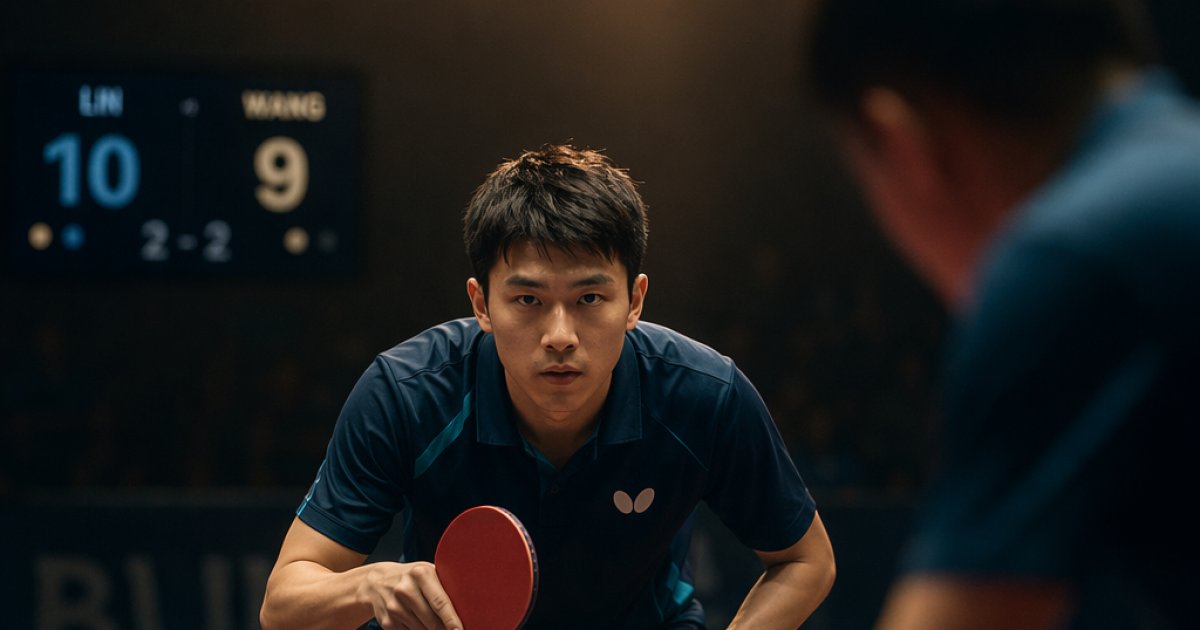
Kayla was up two games to one in a regional match in San Juan, in a gym that smelled like the floor wax they’d used that morning, a lead she’d earned honestly against a player two rating classes above her own. Somewhere in the third game, her hands started shaking so badly between points that she had to press the paddle flat against her thigh just to stop the tremor from showing to the small crowd of parents and clubmates along the wall. She wasn’t scared of losing exactly.
She was scared of losing THIS, a lead she’d never held against a player this good, and the fear had nowhere else to go except straight into her hands. She lost the next four points in a row, not because her technique broke down, but because a shaking hand cannot execute a controlled topspin stroke, and nobody had ever actually taught her what to do about the shaking itself, only that she should, generically, calm down.
Staying calm during a match isn’t a personality some players have, and others don’t. It’s a small set of specific, learnable actions, and most players who look naturally composed are simply running them without announcing it.
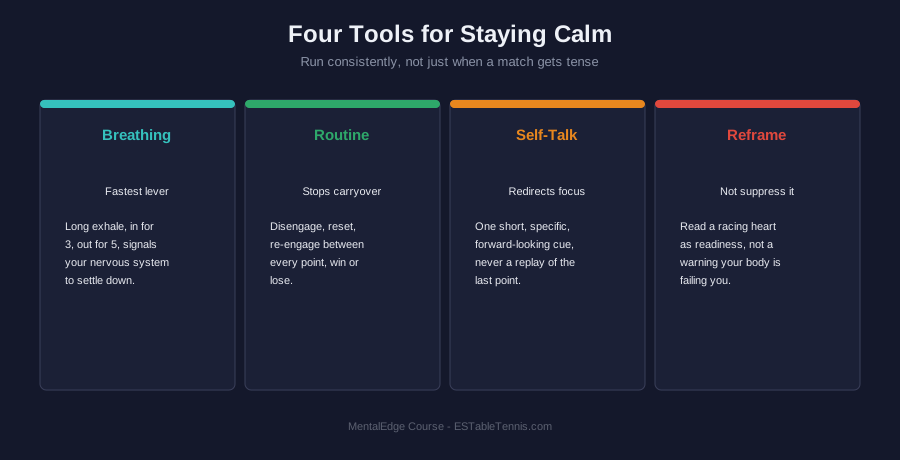
How to stay calm during a table tennis match: run four specific tools consistently rather than trying to will yourself into a feeling. Use controlled breathing to bring your physical state down fast, a fixed between-point routine to stop emotion carrying over from one point to the next, a short self-talk cue to redirect your focus forward, and a deliberate reframe of your own nerves as readiness rather than danger. None of these make the nerves disappear. All four make the nerves stop running the match for you.
Why Can’t You Just Decide to Stay Calm?
Because calm isn’t a decision, it’s a physical state, and physical states respond to specific physical and mental actions, not to willpower alone. Telling yourself to relax while your heart rate is elevated and your grip is tight is a bit like telling a kettle to stop boiling by asking it nicely.
The heat, in this case adrenaline and cortisol already released into your system, has to be brought down by something that actually works on the nervous system, not by an instruction aimed at your mood. This is the mistake Kayla made without knowing it. She kept telling herself to relax, which did nothing, instead of doing one of the four things that actually would have.
This is also why watching a composed opponent can be so misleading. It looks effortless from the outside, which makes it tempting to conclude that some players simply don’t feel the pressure the rest of us do. Almost none of that is true. What’s actually happening, in nearly every case, is a player running one or more of the four tools below quickly enough, and quietly enough, that it reads as natural talent instead of a trained sequence. The skill is invisible by design.
That doesn’t make it any less learnable by someone watching from the other side of the table wondering why their own hands won’t stop shaking.
What’s the Fastest Way to Calm Down Mid-Match?
Controlled breathing, specifically an exhale that runs longer than the inhale, is the single fastest lever you have access to in the middle of a match, faster than a self-talk cue, faster than any physical routine, because it works directly on the nervous system rather than routing through a thought first. A long exhale is one of the only voluntary actions that reliably signals your body to shift out of a heightened state, and it takes about three seconds, well inside the gap you get between points even under the ITTF’s rules on avoidable delay.
The full mechanics and a few variations on the technique are covered in table tennis breathing techniques, but the version worth memorizing right now is simple: in for a count of three, out for a count of five, repeated once more if the gap allows it. This alone won’t fix a match on its own. It buys you the few seconds of steadiness the other three tools actually need in order to work.
Does a Physical Routine Actually Help You Stay Calm?
Yes, more than most players expect, because a routine stops the emotional residue of one point from bleeding straight into the next one, point after point, over an entire match. Without a fixed sequence, whatever you felt after the last point- frustration, adrenaline, dread- simply carries forward uninterrupted into how you play the next one, and it keeps compounding for as long as nothing interrupts it.
The full four-step sequence- disengage, reset, self-talk cue, re-engage- is covered in a table tennis routine between points, and the piece that matters most for staying calm specifically is the first two steps: physically turning away from the table for a moment, and consciously releasing the tension you’re almost certainly holding in your grip without noticing. Kayla’s hands weren’t shaking because she was uniquely nervous. They were shaking because nothing was interrupting the tension between one point and the next, so it just kept accumulating.
What Should You Say to Yourself When You’re Not Calm?
Something specific, true, and forward-looking, and rarely a replay of whatever just went wrong on the previous point. A generic “calm down” carries no useful information and rarely works, since it’s an instruction about a feeling rather than a cue about what to actually do next.
A phrase tied to something concrete, “soft hands, next ball,” or a cue that’s worked for you before, gives your brain somewhere real to go instead of just repeating the demand to feel different. The specific phrases and how to build your own are covered in table tennis self-talk between points, and it’s worth treating this as its own skill, not just an afterthought bolted onto breathing.
Should You Try to Get Rid of Your Nerves Completely?
No, and chasing that goal is part of why players stay stuck. A racing heart before a big point is not a malfunction, it’s your body preparing to perform, and research on reappraising stress responses, most notably work by psychologist Jeremy Jamieson and colleagues on improving acute stress responses through reappraisal, has found that people who relabel the same physical arousal as a resource rather than a threat perform measurably better under pressure than people trying to suppress or eliminate the feeling entirely.
Kayla wasn’t going to walk into a match point up two games to one with a resting heart rate, and trying to force that was never a realistic target. The realistic target is a fast heart rate she’s correctly interpreting as her body getting ready, not a body that’s failing her.
Is This Actually Backed by Research or Just Common Advice?
Genuinely backed, though it’s worth being honest about which parts are well established and which are reasonable extensions of that research applied to a specific sport. The reappraisal work already mentioned, treating arousal as a resource rather than a threat, has been tested across multiple performance domains, from public speaking to competitive exams to athletic performance, with a reasonably consistent finding that reframing beats suppression.
What hasn’t been studied specifically is table tennis, since most of this research comes from broader sport psychology and stress research rather than a table-tennis-specific trial. The application here, four tools translated into a table tennis context, is a reasonable extension of well-supported general principles, not a claim that a peer-reviewed study tested exactly this sequence with exactly this sport. That distinction matters if you want to know how much confidence to place in any single piece of advice you read online, including this one.
The honest position is that the individual pieces- breathing’s effect on physiological arousal, the value of consistent pre-performance routines, and reappraisal outperforming suppression- each have real research behind them from their own fields. What’s original here is the sequencing and the table tennis-specific application, not a brand new discovery about the nervous system.
Is Staying Calm the Same as Not Choking?
Related, but not identical, and it’s worth being precise about the difference. Staying calm is the ongoing, preventive practice you run throughout an entire match to keep your composure roughly consistent from the first point all the way through the last one.
Choking is the specific, acute failure that tends to happen when that composure has already cracked, usually at a moment with unusually high stakes attached to it. The full breakdown of that mechanism and how to reverse it in the moment is covered in how to stop choking in table tennis.
Think of staying calm as the maintenance work and stopping a choke as the emergency repair. Players who genuinely run the four tools above consistently need the emergency repair far less often, which is really the entire point of building the habit before you need it.
Is Staying Calm Different When You’re Already Losing?
The four tools stay completely identical whether you’re up or down. What gets harder is your willingness to actually use them, since losing tends to produce a strong urge to speed up, take bigger risks, and abandon the exact routine that got you into contention in the first place, exactly at the moment slowing back down would help you the most.
This pattern is covered in more depth in how to stop a momentum shift in table tennis and how to handle a losing streak, but the short version worth remembering mid-match is this: the temptation to rush is loudest exactly when patience matters most, and the routine doesn’t know or care whether you’re up or down on the scoreboard. It only works if you run it regardless of the score, not just when things are going your way.
What If You’re Naturally an Anxious Person Off the Table Too?
The four tools still work exactly the same way, but expect to need more repetition before they feel automatic and available without conscious effort, and that’s a realistic expectation to set going in, not a discouraging one. A player whose baseline anxiety runs higher off the table generally needs more practice reps of the routine, the breathing pattern, and the self-talk cue before those tools fire without conscious effort, the same way a beginner needs more reps of a stroke than someone who’s played for years. This isn’t a sign the tools don’t work for you specifically.
It’s a sign you’re starting from a different baseline, and the broader picture on managing this is covered in table tennis anxiety tips. The tools are the same regardless of your starting point. Only the amount of practice needed to make them automatic changes.
What Are the Early Signs You’re Losing Your Composure?
Your pace between points is usually the very first tell, and it tends to show up well before your actual shots start missing. A player staying composed walks back to the ready position at roughly the same speed all match.
A player losing it speeds that pace up without noticing, rushing to serve again as if getting the next point over with faster will resolve the discomfort of the last one. Watch for a second sign right behind it: your grip tightening on the handle between points rather than during the actual stroke, since a tense hand between rallies is a reliable early signal that your physical state is climbing before your technique has caught up to reflect it.
A third sign, quieter than the first two, is your breathing shortening at the top of your chest instead of staying low and full. Most players never check this consciously, which is exactly why it’s worth building the habit of a quick internal scan between points: pace, grip, breath, since catching the drift early gives the four tools something to actually correct before it shows up as a missed shot instead of after.
Does Your Equipment Affect How Calm You Stay?
More than most players account for, and it’s genuinely worth ruling out before assuming a composure problem is purely mental in origin. A racket that doesn’t match your natural swing speed or grip produces inconsistent results for reasons that have nothing to do with your nerve, missed shots you technically executed correctly but that the equipment didn’t return the way you expected.
That inconsistency reads to your nervous system as unpredictability, and unpredictability is one of the most reliable triggers for exactly the kind of rising tension this post is about. A player whose gear behaves consistently has one less source of hidden stress feeding into the match; a player fighting equipment that doesn’t fit their game is adding static to a signal that’s already hard enough to read clearly under pressure.
This is worth checking honestly rather than assuming every composure issue is purely psychological. If you find yourself getting tense specifically after mishits that felt technically fine on your end, a fitted recommendation from PingPath is a faster diagnostic than months of mental training aimed at a problem equipment might be causing.
How Do You Actually Practice Staying Calm Before It Matters?
In low-stakes matches, deliberately and repeatedly, well before you ever actually need any of it in a match that carries real stakes. Run the breathing pattern, the between-point routine, and your self-talk cue in practice games against a training partner, even ones that mean nothing, specifically because they mean nothing.
This is the exact same principle that applies to building genuine confidence: the tools have to become boring and automatic somewhere safe before you can trust them somewhere that isn’t. Players who save these tools for the first time a match actually matters are, in effect, trying to learn a new skill under the worst possible conditions to learn anything.
Frequently Asked Questions
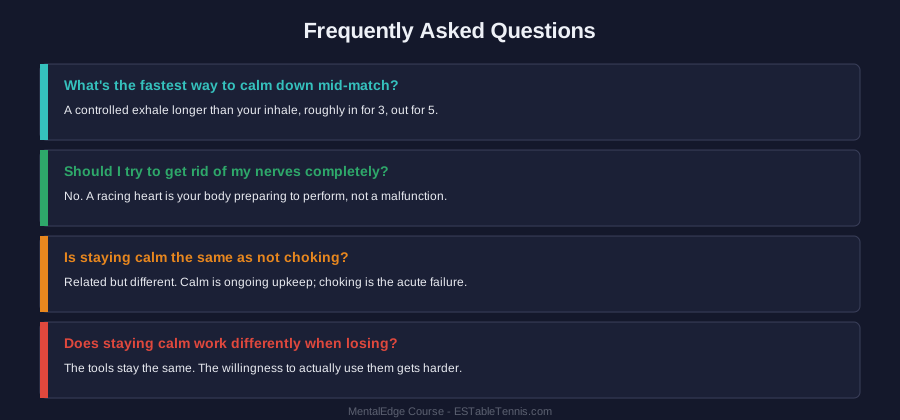
What’s the fastest way to calm down during a table tennis match?
A controlled exhale longer than your inhale, roughly in for three, out for five. It’s the single fastest voluntary action available to you between points and takes only a few seconds.
Should I try to get rid of my nerves completely?
No. A racing heart before a big point is your body preparing to perform, not a malfunction. Relabeling the sensation as readiness rather than danger works better than trying to eliminate it.
Is staying calm the same as not choking?
They’re related but different. Staying calm is the ongoing practice that keeps your composure consistent. Choking is the acute failure that tends to happen once that composure has already cracked.
Does staying calm work differently if I’m already losing?
The tools stay the same. What gets harder is your willingness to use them, since losing creates an urge to rush and abandon your routine right when patience matters most.
Kayla didn’t win that match in San Juan. She lost the third game and then the fourth, and the shaking never fully settled that day; no single insight fixes a habit that’s had years to form in a single afternoon. But she went looking afterward for what actually stops it, past the generic advice she’d been given her whole playing life, and found the four tools instead of another vague pep talk. She drilled them for months in matches that meant nothing to anyone but her.
The next time she held a lead that actually mattered, against a player just as strong, her hands stayed still enough to finish what she started, and she didn’t feel calm doing it. She felt exactly as much adrenaline as the girl who lost 11-2 that day in San Juan. She had just finally learned what to do with it.
Calm in a match is not a personality trait. It is a set of small skills, practiced until they hold when the score gets loud, and every one of them is learnable.If you want the complete system, breathing, routine, self-talk, and arousal reframing- built out step by step rather than pieced together from separate posts- the MentalEdge Course walks through all four together.
Leave a Reply