Every search for “the best table tennis paddle” eventually leads to the same dead end: a ranked list confidently naming one winner, as if forty million players with forty million different swings, temperaments, and physical strengths could all be served by the same single answer.
There is no best paddle. There’s only the best paddle for a specific player, at a specific stage, and pretending otherwise is exactly how so many good players end up frustrated by equipment that was never actually wrong, just wrong for them.
What’s the best table tennis paddle?
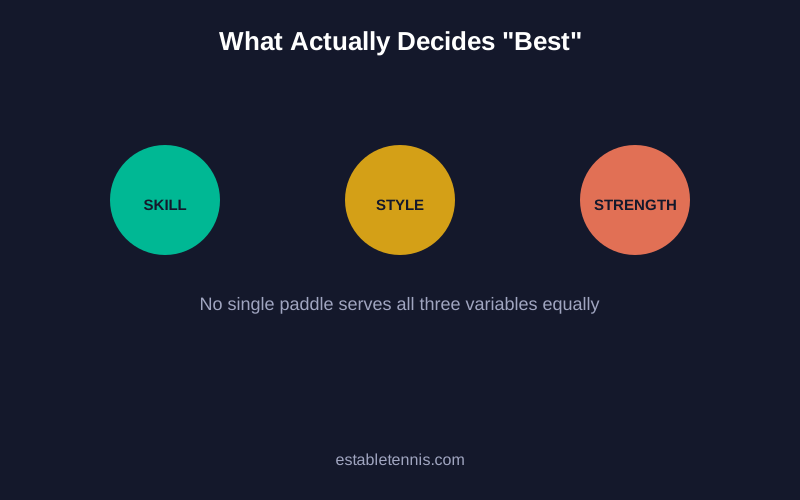
There isn’t a single best paddle: the right choice depends on skill level, playing style, and physical strength.
Beginners need forgiving, moderate specs; intermediate players need setups matching their developing style; advanced players need equipment that rewards already-consistent technique. “Best” only makes sense relative to the specific player holding it.
This question deserves a more honest answer than any ranked list can offer, because the honest answer requires knowing something about you specifically, not just about paddles in general.
Why doesn’t a single “best paddle” actually exist?
Because paddle performance depends entirely on the player using it: the same fast, offensive-rated paddle that feels incredible in an advanced player’s hands can feel wildly inconsistent and frustrating for a developing player whose technique isn’t ready for that speed yet, covered in our guide on is a carbon blade good for beginners.
Fit, not raw quality, determines whether a paddle is genuinely good for a specific person.
What’s the best paddle for a genuine beginner?
A moderate, forgiving premade setup with medium speed and spin ratings, covered in depth in our guide on ping pong paddles for beginners.
At this stage, forgiveness and consistency matter more than any spec that promises more power or spin than a developing player can actually control yet.
What’s the best paddle for an intermediate player looking to upgrade?
One matched specifically to whatever style has actually emerged through real match experience: more aggressive rubber and a carbon or ALC blade for a player who’s developed genuine offensive consistency, or more control-oriented equipment for a player whose game leans toward patient, defensive placement, covered in our guide on offensive vs defensive style.
What’s the best paddle for an advanced, competitive player?
Whatever setup rewards the specific technical strengths that player has already built, which varies enormously between individuals even at a similar skill level.
Two advanced players can have completely different “best” paddles, since one might favor an aggressive full-carbon blade for maximum looping power while another favors a more controlled ALC setup that better suits their particular tactical approach.
How should someone actually go about finding their own best paddle, rather than trusting a ranked list?
Start with the forgiving, moderate specs appropriate to your current skill level, then let real match feedback over months, not a single session, reveal what your specific game actually needs.
This patient, personal process consistently outperforms any generic ranking, since a ranking was never built with your actual swing in mind.
Does price correlate with finding your genuinely best paddle?
Only loosely. A well-matched, moderately priced paddle will outperform an expensive, poorly matched one for the specific player using it every time.
Price reflects material and manufacturing quality, not fit, and fit is what actually determines whether a paddle deserves to be called “best” for any individual player.
Should a player’s “best paddle” stay the same forever once found?
No. As a player’s technique, style, and physical strength evolve, what counts as their best paddle evolves alongside it.
A setup that was genuinely the best fit during a player’s first year often stops being the best fit once their game matures into something different, which is why equipment reassessment remains a periodic, ongoing process rather than a one-time decision.
Why do ranked “best paddle” lists persist despite this obvious problem?
Because they’re built for search volume and affiliate commission rather than genuine personalized fit, covered in depth in our piece on why most rubber recommendations online are wrong.
A ranked list format is easy to produce, easy to rank in search results, and easy to monetize, none of which has anything to do with whether the top-ranked paddle actually suits the specific reader clicking through to buy it.
How does blade weight factor into finding a genuinely best-fit paddle?
Significantly, covered in our guide on table tennis blade weight. Two paddles with identical rubber and similar price can feel completely different in hand depending on weight and balance point, and a “best” paddle recommendation that ignores this variable is only telling half the story regardless of how confidently it’s presented.
Does a player’s physical strength and conditioning affect what counts as their best paddle?
Yes, meaningfully. A player with less developed forearm and wrist strength benefits from a lighter, more forgiving setup regardless of skill level, while a player with strong physical conditioning can handle heavier, more demanding equipment that would fatigue or overwhelm someone else with identical technical skill but different physical attributes.
How does rubber hardness specifically complicate the search for a single best paddle?
Enormously, covered in our guide on table tennis rubber hardness explained. The same paddle can feel completely different depending on a player’s actual swing speed, since harder sponge demands faster racket-head acceleration to compress properly, a variable no generic ranking can account for without knowing the specific player’s swing characteristics.
What’s a more honest way to search for equipment than typing “best table tennis paddle” into a search engine?
Start from your own actual situation (skill level, playing style, physical strength, budget) and work outward from there, rather than starting from a generic ranking and hoping it happens to match your specific circumstances.
This reversal, personal situation first, ranking second, produces considerably better equipment decisions than the reverse order most buyers default to.
Is there ever a legitimate use for a “best paddle” ranked list?
Somewhat, as a starting point for research rather than a final answer: a well-constructed list can introduce specific models and specs worth investigating further, but it should never be treated as the final word on what to actually buy without considering how those specs interact with your own particular game.
How does the concept of a “best paddle” differ between someone buying their very first setup and someone on their fifth or sixth?
A first-time buyer’s best paddle is almost always the most forgiving, moderate option available, since they have no real feedback yet on their own developing style.
A fifth or sixth setup purchase, by contrast, is informed by years of accumulated feedback about exactly what that specific player’s game actually rewards, making the search considerably more targeted and personal than a beginner’s necessarily broader, more cautious first decision.
Does the sport’s own competitive structure implicitly reward equipment diversity rather than a single dominant setup?
Genuinely, yes. If one truly universal best paddle existed, it’s reasonable to expect every top competitive player would converge on identical equipment, and they demonstrably don’t: elite players across every playing style use meaningfully different blade constructions, rubber types, and weights, which is itself strong evidence that fit, not a single objectively superior product, determines what actually works at the highest levels of the sport.
How should someone weigh online reviews when trying to find their own best-fit paddle?
Reviews are most useful when the reviewer’s playing style, skill level, and physical characteristics are reasonably similar to your own, since a review from a fundamentally different type of player carries limited relevance to your specific situation.
A glowing review from an aggressive offensive looper tells you relatively little if you’re a patient defensive player evaluating the same paddle for a completely different tactical purpose.
What’s the role of a coach or experienced club member in helping someone find their genuinely best paddle?
Considerable, and often more valuable than any amount of independent online research, since a coach who’s actually watched a player’s swing and style has direct, specific information no generic review or ranking could ever replicate.
A five-minute conversation with someone who’s observed your actual game in person frequently outperforms hours spent reading reviews written by strangers with no knowledge of your specific technique.
Does climate or playing environment affect what counts as a best-fit paddle?
Somewhat, covered in our guide on table tennis rubber hardness explained. Sponge hardness shifts slightly with temperature and humidity, meaning a paddle that feels ideal in a climate-controlled indoor hall might play subtly differently in a hot, humid, unconditioned space, which is a genuinely underappreciated variable in the search for a personally optimal setup.
How does budget realistically factor into finding a genuinely best-fit paddle without overspending?
Most of the meaningful fit variables (speed rating, spin rating, sponge hardness, weight) exist across every price tier, meaning a moderately priced paddle can be just as well-matched to a specific player as an expensive one.
Overspending on features irrelevant to your actual current skill level, like extreme offensive speed ratings a developing player can’t yet control, wastes money without improving genuine fit at all.
What’s the most reliable single piece of advice for anyone still searching for their best paddle?
Stop searching for a universal answer and start honestly assessing your own current skill level, style, and physical characteristics first.
Every genuinely useful equipment decision on this entire site starts from that same personal starting point rather than from a generic ranking that was never built with any specific reader in mind.
According to the ITTF equipment regulations, every legally approved paddle meets the same baseline standards regardless of price or marketing tier, meaning the difference between a good and bad fit was never actually about legality or a hidden quality gap: it was always, entirely, about matching specs to the specific player holding the racket.
The search engine will keep returning ranked lists no matter how many times this question gets asked, because that’s the format search engines reward. It has never once been the format that actually answers the question honestly.
An honest answer to this question requires more effort than a ranked list ever will: it requires actually sitting with your own skill level, your own natural style, your own physical strength, and being willing to admit those things might point toward a different paddle than whatever tops the search results this month.
That honesty is uncomfortable in a way clicking a top-ranked link never is, which is exactly why so few buyers ever bother with it.
Those who do bother, though, consistently end up happier with what they eventually buy, precisely because the decision was built around them instead of around a generic audience the ranking was actually written for.
Every question phrased with the word “best” invites a lazy, universal answer, and this sport’s equipment landscape punishes that laziness more directly than most, since a genuinely mismatched paddle shows up immediately in every single rally rather than sitting quietly unnoticed the way a poor fit sometimes does in other purchases.
Forty million swings really is the honest scale of this problem, and no single product, regardless of price or reputation, was ever built to serve all of them equally well.
Yours is one specific swing among those forty million, and it deserves an answer built around it specifically, not one built around the largest possible audience a content team could reasonably target.
Ask better questions of yourself before asking a search engine one. What’s your actual skill level, honestly assessed rather than aspirationally inflated?
What does your game actually reward right now, not what you wish it rewarded? Answer those two questions truthfully first, and the equipment search that follows becomes considerably shorter and considerably more useful than any ranked list could ever make it.
The ranking will still be there tomorrow, still confidently naming one winner, still wrong for most of the people who click through it. That’s fine. It was never actually written for you specifically anyway, and now you know exactly why.
Skip it this time. Start from your own honest assessment instead, and let the actual answer follow from that, rather than the other way around.
Your best paddle is out there somewhere, matched to a swing that belongs entirely to you. No search engine ranking will ever hand it to you directly, since it was never built to look that closely at any single reader.
Finding it takes patience, honest self-assessment, and a willingness to ignore whatever tops the search results this particular week.
Every rally you’ve ever won or lost was decided partly by that fit, whether you’d ever thought about it that way before or not.
Worth thinking about before your next purchase, not after another season spent blaming the wrong variable entirely.
Simple as that.
Assess yourself honestly first. Everything else about this decision follows naturally from that single, uncomfortable step.
End of story.
Forty million swings, forty million answers. Yours is waiting to be found on its own terms.
Go find it.
Nobody else can find it for you.
Start today.
Truly.
Really, today.
Skip the ranked list, skip the affiliate links, and start from the one honest question every good equipment decision on this site actually begins with: what does your own game, right now, actually need.
Answer it honestly.
Then buy accordingly.
Good luck.
Quick Recap: Best Table Tennis Paddle
The best table tennis paddle was never a single product waiting to be crowned: it’s whatever setup actually fits the player holding it, at whatever stage of development they’re currently in.
Every ranked list confidently naming one universal winner is answering a question that, examined honestly, was never actually answerable that way in the first place.
Frequently Asked Questions
Is there really no single best table tennis paddle?
What’s the best paddle for a beginner specifically?
Does a more expensive paddle mean it’s a better fit?
Should my best paddle stay the same forever?
Can I trust a “best paddle” ranked list at all?
Forty million players, forty million swings, and exactly zero single correct answers to a question that only ever sounded like it had one.
Want a paddle recommendation actually built around your specific game, not a generic ranking? PingPath gives you a fitted setup in under three minutes.
Leave a Reply