Most rubber recommendations online never once ask who you actually are before telling you what to buy.
Somewhere right now, a roundup article titled “Best Rubber for Beginners in 2026” is being read by someone who has never touched a table tennis racket, written by someone who last played competitively a decade ago, optimized for whichever product happens to pay the highest affiliate commission this quarter.
Neither the reader nor the writer will ever know this transaction happened. That’s the quiet scandal sitting underneath most rubber recommendations online, and almost nobody in the sport is willing to say it out loud.
The truth is rarely pure and never simple, and it is especially not simple when the entire business model of a website depends on you clicking a link and buying whatever sits at the top of a list.

Why do most rubber recommendations online exist in the first place?
Because rubber has an affiliate commission attached to it, and content built around a purchase decision converts.
Ask yourself, honestly, how many “best rubber” articles you’ve read that were written by someone who asked a single question about your playing style before making a recommendation.
The answer is almost always zero, because the article was never actually about you. It was about search volume and commission rates, dressed up in the language of helpful advice.
What does a generic “best beginner rubber” list actually optimize for?
Clicks, affiliate conversions, and search rankings, in roughly that order. It does not optimize for whether a fast rubber will terrify a naturally cautious player into a permanently shortened, defensive swing, or whether a control-oriented rubber will bore an aggressive player into abandoning the sport within a month.
Equipment fit is personal, situational, and psychological. A ranked list is none of those things. It is a static artifact pretending to answer a question that changes depending entirely on who’s asking.
Why does the wrong rubber recommendation actually matter this much?
Because rubber choice isn’t just a technical decision: it’s a mental one wearing a technical disguise, the same crossover thesis running through everything on this site.
A fast rubber handed to a naturally cautious, control-oriented player doesn’t just play badly. It creates a low-grade, persistent anxiety every time that player swings, because the equipment is fighting an instinct the player didn’t choose and can’t easily override.
A slow, forgiving rubber handed to a naturally aggressive player creates the opposite problem: frustration at equipment that seems to punish exactly the kind of committed swing that player’s temperament wants to produce.
Who actually gets hurt by this, specifically?
New players, disproportionately. An experienced competitor has enough hours on the table to recognize a bad equipment fit within a few sessions and correct course.
A beginner has no such reference point. They read a “best beginner rubber” list, buy exactly what it says, and then spend months blaming their own technique for problems that were sitting in the sponge the entire time.
Some of them quit before ever discovering the actual issue was never their swing.
Is this a conspiracy, or just an incentive problem?
Just an incentive problem, and that’s arguably worse, because it means nobody involved has to be malicious for the outcome to be bad.
A content writer isn’t lying when they call a rubber “great for beginners”: they genuinely believe it, in the same shallow way a person can genuinely believe a fact they’ve never actually tested against reality.
The incentive structure of affiliate content simply never asked the harder, more expensive question: great for which beginner, with which physical strength, which temperament, which specific style already forming?
What would an honest rubber recommendation actually require?
Information nobody publishing generic content has access to: your current swing speed and consistency, whether you tend toward caution or aggression under pressure, your physical strength and stamina, and what you actually want your game to become, not just what you’re doing today.
A ranked list has none of this. It has a keyword and a commission rate.
What should you actually do instead of trusting a roundup list?
Start with the forgiving, mid-range specifications covered in our guide on choosing rubber for beginners, which exist precisely because they work reasonably well across a wide range of temperaments while you’re still discovering your own.
Then pay attention (genuine, deliberate attention) to how a specific setup makes you feel across real sessions, not a single afternoon. The right rubber for you was never going to be found on a list built for everyone.
How would you even spot a genuinely honest rubber recommendation if you saw one?
It would ask you questions before it answered any of its own. It would admit that a fast, tacky offensive rubber is a poor beginner choice even though it’s more expensive and carries a bigger commission.
It would tell a naturally cautious player to stay away from a rubber the same article might recommend to an aggressive one, rather than pretending one sheet of rubber serves every reader equally.
Honest advice looks narrower than a ranked list, not broader, because it’s actually trying to fit a specific person rather than capture the widest possible search audience.
Why does nobody call this out more directly?
Because the entire content ecosystem around equipment reviews runs on the same incentive, which makes calling it out a little like one fish complaining about water.
Sites that rely on affiliate revenue rarely have a strong motivation to tell their readers that the entire format (the ranked list, the “best of” roundup) is structurally incapable of giving them what they actually need.
It’s not that anyone is hiding this. It’s that almost nobody in the business of selling equipment through content has a reason to say it plainly.
What’s the actual cost of following bad advice, beyond a wasted purchase?
Money is the smallest part of it. The real cost is time: months spent blaming a developing swing for problems that were sitting in a mismatched sponge the entire time, and the quieter cost of confidence, since a player who keeps missing shots for reasons they can’t diagnose starts to doubt their own hands rather than their gear. Some of those players never come back to find out it was never their fault.
None of this requires a villain. It just requires someone, eventually, to say plainly that a list built for everyone was never going to be the right answer for you specifically.
Equipment doesn’t give you confidence. It removes the excuses that were already eating it, or it hands you a fresh one, depending entirely on whether anyone bothered to match it to the player actually holding it.
Most of the internet’s rubber advice was never built to do that matching. It was built to sell whatever was already in stock.
Want a recommendation actually built around your playing style instead of an affiliate commission? PingPath gives you a fitted setup in under three minutes, with nothing to sell you except the right answer.
Honest rubber recommendations start from your game. Generic rubber recommendations start from someone else\’s incentives.
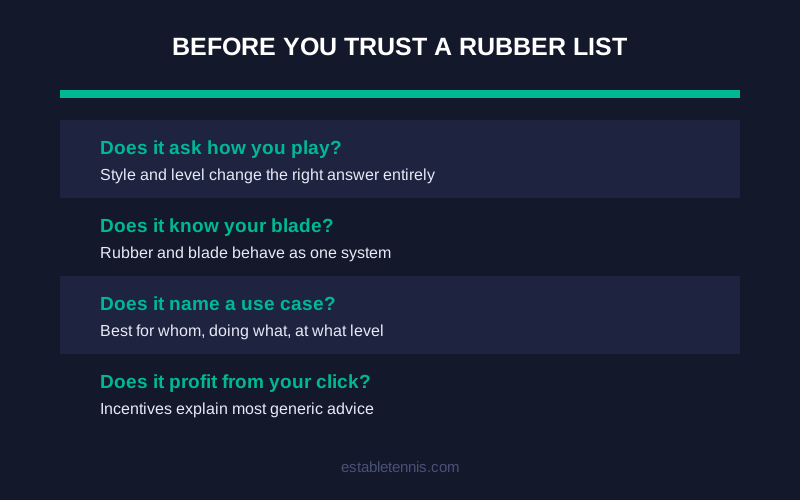
Quick Recap: Rubber Recommendations Online
Rubber recommendations online will keep optimizing for commission rates over fit until enough readers demand better. Until then, the honest version of this advice starts with your own swing, not a ranked list built for everyone at once.
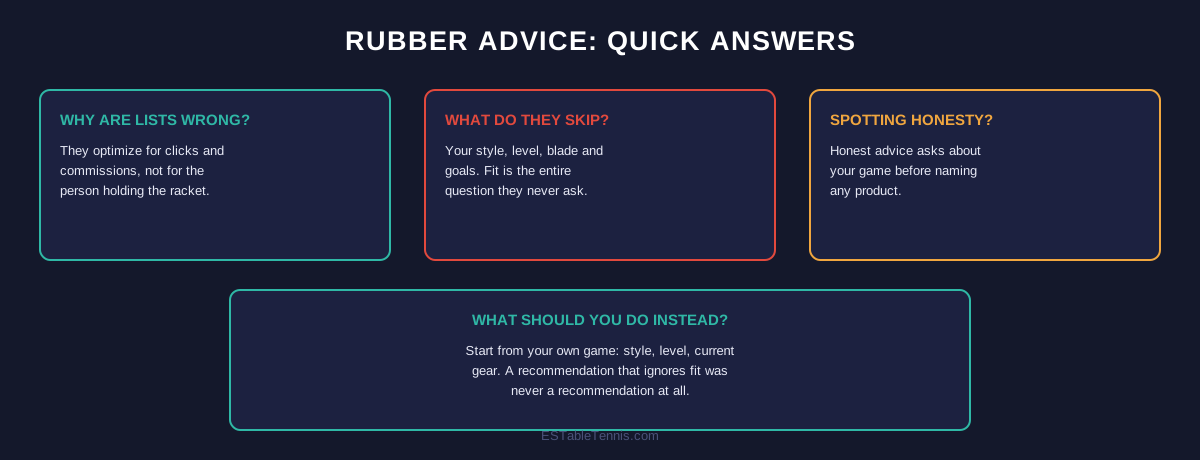
Frequently Asked Questions
Can you actually trust any rubber recommendation online?
Why do affiliate sites recommend the same few rubbers repeatedly?
Is it better to ask a coach than read online reviews?
According to ITTF equipment regulations, every legal rubber on the market meets the same baseline approval standard, which means the difference between a good and bad recommendation was never about legality or quality tier. It was always about fit.
Leave a Reply