
A boy named Marlon showed up to a real club night in Scarborough with a paddle his mother had bought at a pharmacy on the way, nine dollars, a picture of a smiling cartoon ball on the plastic wrapper. He had been hitting a ball against his garage door for three months and thought he was ready. He lost eleven-nothing, then eleven-two out of pity, to a twelve-year-old girl who had been playing for four months on a paddle that cost nineteen dollars more.
The gap wasn’t talent. Both children were new to the sport, both were coordinated, both wanted it badly enough to show up on a Tuesday night. The gap was that her paddle had actual sponge under the rubber and his had a sheet of stiff red plastic pretending to be sponge, the kind that sends the ball off at angles no beginner can predict or correct for. He wasn’t losing a table tennis match. He was losing an argument with his own equipment, and nobody in that gymnasium bothered to tell him that.
Forty dollars spent on the wrong kind of paddle teaches you nothing except that you’re bad at a sport you might actually be good at. Forty dollars spent on the right kind teaches you your own hands.
Most “under $50” buying guides just list whatever is cheap and call it a bargain. That’s not what this is. This is the best ping pong paddle under $50 you can actually buy right now: every pick below is a real, current, in-stock product, not a discontinued listing left up to collect affiliate clicks, and every one of them earns its place because of what it does for a beginner’s hands, not because of what it does for a marketing budget.
What Does ‘Under $50’ Actually Buy You Right Now?
Under $50 buys you a real, verified-in-stock beginner setup, either a ready-to-play paddle or a separate blade-and-rubber build, as long as you avoid pharmacy and toy-aisle products. Here’s something most buying guides won’t tell you: a large share of the “premade paddle” market between twenty and fifty dollars is, at any given moment, simply not available. Brands run out, restock slowly, and the listings that stay up regardless of stock are exactly the ones a lazy guide will still recommend to you. I checked every product on this list against live stock before writing a word about it, and I’m telling you that upfront because it changes what an honest recommendation looks like at this price point.
I didn’t pull this list from a spec sheet or a manufacturer’s press kit. Every paddle and blade below was checked directly on the retailer’s own product page, at the time this was written, for three things: whether it was genuinely available to buy right now, what it actually costs including any current discount, and whether the rubber or construction matched what a beginner or improving player needs rather than what a marketing paragraph claims.
A handful of well-known models that would otherwise belong on this list, from a couple of JOOLA’s mid-tier combo rackets to a Butterfly starter set, got left off entirely because they were sitting behind a “notify me when back in stock” button. A recommendation you can’t actually buy isn’t a recommendation. It’s filler.
What it means practically is this: your forty-dollar options split into two honest categories, not one. There’s the ready-to-play paddle, glued and boxed by the manufacturer, where you open it and start hitting. And there’s the smarter buy for anyone who plans to stick with the sport past a few weekends: a real blade paired with your own choice of rubber, built the way a coach would actually build it for you. Neither one is a compromise. They’re just answers to two different questions.
Should You Buy a Ready-to-Play Paddle or Build Your Own?
Buy ready-to-play if you’re not sure you’ll stick with the sport. Build your own blade-and-rubber setup if you already know you want to improve. If you don’t know yet whether you’ll still be playing in six months, buy ready-to-play. There’s no shame in it and no wasted money in it. A quality boxed set from a real manufacturer will teach you the same fundamentals a custom setup will, and you can always upgrade the moment you know what you’re upgrading toward.
If you already know you want to get good, and forty or fifty dollars is genuinely your ceiling for now, the smarter move is a separate blade and a separate sheet of rubber. It costs almost nothing extra in time; it lets you replace just the rubber when it wears out instead of the whole paddle, and it puts you on the same equipment path a serious player eventually walks anyway. I go through the mechanics of that decision in more detail in How to Choose a Table Tennis Blade, and it’s worth reading before you commit to either path.
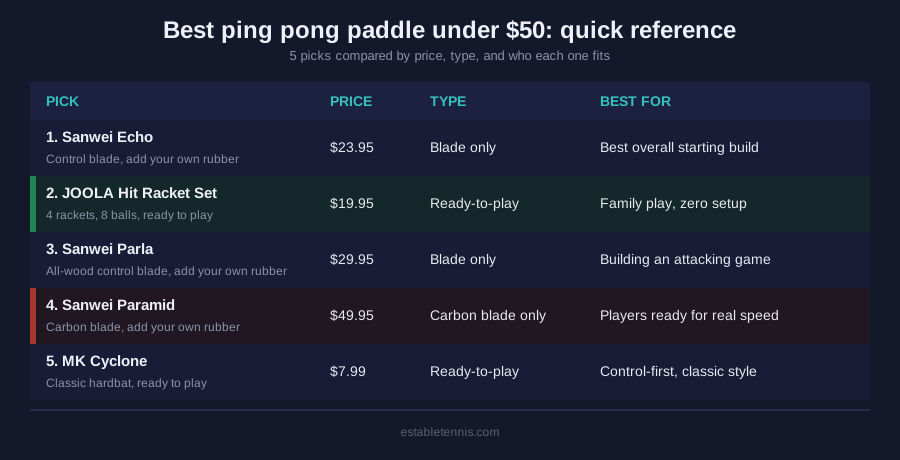
What Are the 5 Best Ping Pong Paddles Under $50?
Every one of these was confirmed in stock at the time of writing, priced under fifty dollars, and chosen for what it actually does in a beginner’s or improving player’s hands, not for how it photographs on a shelf.
1. Sanwei Echo: The Best Overall Starting Build
Sanwei Echo is a five-ply all-wood blade built around a soft Limba surface and a thick core, and it’s the single best foundation on this list for a new player who wants a setup they’ll actually keep. It’s forgiving off-center, honest about mistimed shots, and light enough at eighty grams that it won’t fight your arm through a long practice session. Pair it with a soft rubber sheet, and you have a real player’s setup for well under fifty dollars total, not a toy.
2. JOOLA Hit Racket Set: The Best Zero-Assembly Pick
JOOLA Hit Racket Set gets you four ready-to-play rackets and eight balls for well under twenty dollars, which works out to under five dollars a paddle. This is the right pick for a family table, a first-timer who isn’t sure they’ll stick with the sport yet, or a coach who needs spares that won’t disappear from a duffel bag without much loss. It won’t win you a club match. It will get a total beginner rallying on day one, which is the entire point of a first paddle.
3. Sanwei Parla: The Best Pick for Building an Attacking Game
Sanwei Parla is a seven-ply all-wood blade built with control as the priority but enough pace underneath it to grow into a loop-heavy style once your stroke catches up. It’s the pick for a player who has already decided, even a few months in, that they want to attack rather than block, and who’d rather buy one blade that grows with them than replace a beginner paddle twice in a year.
4. Sanwei Paramid: The Best Pick for Players Ready for Real Speed
Sanwei Paramid sits right at the fifty-dollar ceiling for a reason: it’s a carbon-reinforced blade, not the plain wood the rest of this list is built on, and carbon changes the conversation. It’s faster off the sponge, softer feeling than most carbon blades at this price, and built for a player who has outgrown the forgiveness of a pure control setup but isn’t ready to spend triple the money to get there. Treat it as the graduation pick on this list, not the starting one.
5. MK Cyclone: The Best Classic Control Pick
MK Cyclone is a hardbat, a pips-out paddle with no sponge underneath, the same style of racket professional players used before sponge rubber existed. At under eight dollars, it’s the cheapest thing on this list by a wide margin, and it isn’t a downgrade so much as a different game entirely: shorter, flatter, control-first rallies where spin comes from technique instead of equipment. It’s a genuinely good pick for a player who wants long, readable exchanges while they’re still learning to read the ball at all.
How Do You Pair a Blade With Rubber Without Blowing the Budget?
Pair your blade with one consistent, soft rubber sheet on both sides rather than two different sheets, to stay in budget and learn one feel. If you’ve picked one of the three blades above, the rubber you glue onto it matters as much as the blade itself, and this is where a lot of beginners quietly overspend. You don’t need two different rubber sheets to start. One consistent sheet on both sides, something soft and forgiving, keeps the whole setup close to budget and teaches you one feel instead of two.
I covered exactly which sheets do that job well in Best Rubber for Beginner Table Tennis Players, and the mechanics of why sponge thickness and hardness matter more than brand name in Rubber and Sponge in Table Tennis. Read either one before you glue anything on, because the wrong rubber on the right blade produces the same frustrated, off-the-end-of-the-table misses as the wrong paddle entirely.
What Does a Complete $43 Paddle Setup Actually Look Like?
A complete, coach-approved setup costs around forty to forty-five dollars: a blade like the Sanwei Echo, one sheet of soft rubber applied to both sides, and a tube of water-based glue. Numbers make this easier to trust than adjectives do, so here’s an actual build instead of a vague promise that “custom is affordable.” Take the Sanwei Echo blade at $23.95 and glue on one sheet of a soft, forgiving rubber, cut and applied to both the forehand and backhand side rather than bought twice as two separate sheets.
A single sheet in the entry-to-mid tier, the kind covered in the rubber guide linked above, typically runs somewhere in the high teens to low twenties. Add a two-dollar tube of water-based glue, and you land at a complete, real, coach-approved setup for somewhere around forty to forty-five dollars, comfortably inside the budget this whole guide is built around.
Compare that to a forty-dollar boxed paddle from a brand you don’t recognize, where the “premium carbon fiber” claim on the packaging is doing all the selling and none of the sponge underneath it has been tested by anyone who plays. Same money. Completely different outcome for your first six months.
Why Isn’t the ‘Best’ Paddle the Same for Everyone?
The best paddle depends on how you already move, not just your budget. A compact, patient stroke suits a control blade; a big swing suits a faster one. A buying guide that tells you there’s one correct answer is lying to you a little, and it’s worth saying so directly. The right paddle depends on how you already move, not just on your budget. A player with a compact, controlled stroke and a lot of patience for long rallies gets more out of the Echo or the Parla, both of which reward precision over raw power.
A player who naturally swings big and wants the ball to do something dramatic the moment it leaves the paddle is better served working toward the Paramid, or accepting that a plain wood blade will always feel like it’s holding them back, because in that specific case, it is.
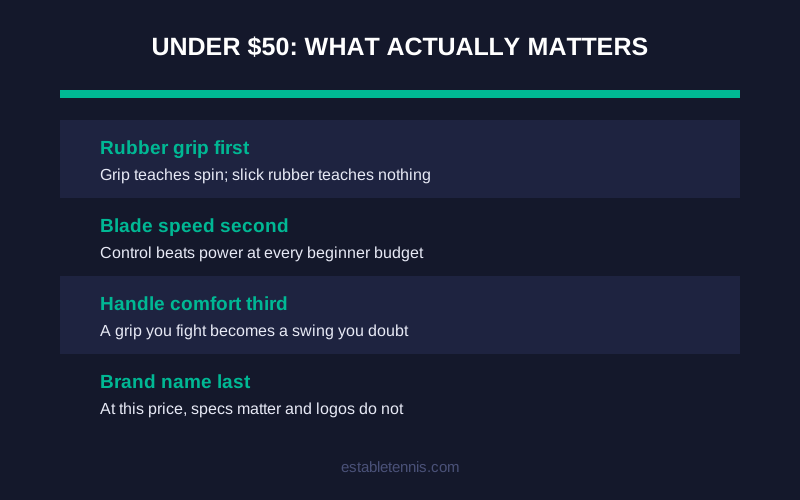
This matters more than most equipment guides admit, because a paddle that fights your natural swing doesn’t just slow your progress; it makes you doubt a swing that might have been fine all along. Mismatched equipment and shaken confidence travel together more often than players realize, and sorting out which one is actually the problem is half of what a decent coach does in the first five minutes of a lesson.
What Should You Avoid When Buying a Paddle Under $50?
Avoid pharmacy or toy-aisle paddles, sets bought purely for the net and balls, assuming higher price always means better, and trusting listings that are actually out of stock. A handful of mistakes show up over and over at the under-fifty-dollar tier, and every one of them is avoidable once you know what you’re looking at.
Buying anything sold at a pharmacy, a toy aisle, or a general department store is the most common one. These aren’t cheaper versions of a real paddle. They’re a different product entirely, built with rigid pips-out plastic standing in for sponge, and no amount of practice will teach you a repeatable stroke on one, because the equipment itself behaves inconsistently from shot to shot.
Buying a “set” purely because it includes a net and balls is the second mistake. The accessories are rarely the problem, but a bundled net is often flimsy enough that it warps within a few weeks, and you end up buying a proper one anyway. Judge the paddle on its own merits and treat anything else in the box as a bonus, not a reason to buy.
Assuming a higher price always means a better beginner paddle is the third, and it’s backward. The ITTF’s approved equipment list includes plenty of rubber and blade combinations built for players who can already generate their own power and spin, and putting that gear in a beginner’s hands removes forgiveness they still need. Nothing on this list is expensive, and nothing on it needs to be.
Trusting a listing that’s actually out of stock is the fourth, and it’s the one this guide was written specifically to avoid. A dead affiliate link sends you either to a “notify me” page that goes nowhere for months, or worse, to whatever the retailer happens to be pushing that week as a substitute.
Every pick above was verified live, and if you’re reading this months after it was published and something has gone out of stock in the meantime, treat that as a reason to check the current listing yourself before buying, not a reason to assume the recommendation was wrong.
Frequently Asked Questions
What’s the Real Cost of Buying the Wrong Paddle?
Marlon came back to the club three more times after that first eleven-nothing loss, still on the pharmacy paddle, because nobody had explained to him or his mother that the problem wasn’t him. He quit after the fourth night, not because he lacked the coordination or the will, but because he’d spent a month concluding he simply wasn’t any good at something that, on the right equipment, he almost certainly was.
That’s the actual cost of buying the wrong thing under fifty dollars, and it’s exactly why the best ping pong paddle under $50 is never just the cheapest listing that happens to be in stock. It was never really about the nine, or the nineteen, or the forty dollars. It’s about whether the first month of a sport teaches a person something true about themselves or something false about a paddle they never should have been sold in the first place.
Run your first setup through PingPath before you spend a dollar, so the paddle you buy tells you the truth from the first rally.
Leave a Reply