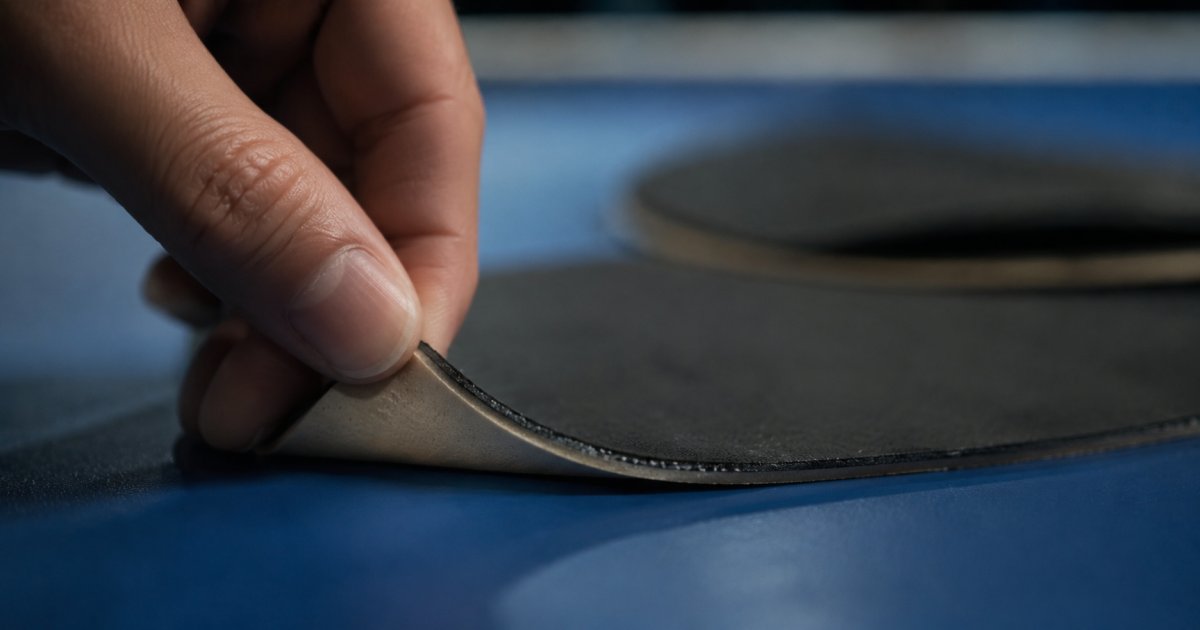
A nineteen-year-old named Kyron walked into a practice session in Chaguanas holding a paddle he was furious about. He had bought the exact rubber his favorite pro used, the same brand, the same name printed on the sponge in the same red lettering, and it played nothing like the highlight clips he’d watched a hundred times. The ball died on contact. Loops that should have screamed off the blade just flopped over the net like wet laundry. He wanted to know what was wrong with the rubber.
Nothing was wrong with the rubber. He’d bought the right topsheet and the wrong sponge, and he didn’t even know sponge was a separate decision. Most players don’t. They talk about “rubber” as one object, the way you’d talk about a shoe, and they never stop to notice that a table tennis rubber is actually two different materials glued together, each one doing a completely different job. Get this wrong and you can spend two hundred dollars chasing a feel you’ll never find, because you bought half of what you needed.
The relationship between rubber and sponge is the single most overlooked decision in table tennis equipment, more overlooked than blade choice, more overlooked than grip, because it hides inside a single product listing labeled with one price and one name. Understand how rubber and sponge actually work together, and a lot of confusing equipment problems stop being mysteries.
What Are Rubber and Sponge in Table Tennis?
Table tennis rubber is actually two materials glued together: the topsheet on top, which grips the ball and creates spin, and the sponge underneath, which compresses and releases energy to create speed. Strip a table tennis rubber down to its parts and you find two layers. On top sits the topsheet, the thin sheet you see and touch, sometimes smooth, sometimes covered in pimples. Underneath sits the sponge, a softer foam layer you never see once it’s glued to the blade.
The topsheet grips the ball. It’s the surface that creates spin, the part responsible for that grabbing sensation when a good loop drive bites into the ball and sends it tumbling. The sponge does something different. It compresses on contact, stores energy like a tiny spring, then releases that energy back into the ball as it leaves the racket. Speed comes from the sponge far more than people assume.
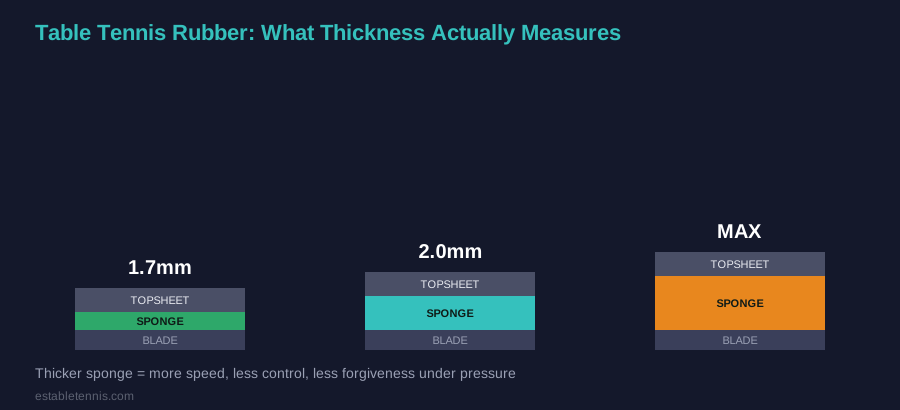
This is the part Kyron missed. He matched the topsheet. He never thought about the sponge underneath it, because most retail listings bury that detail three lines down in the product description, after the brand name and the color.
What’s the Difference Between the Topsheet’s Job and the Sponge’s Job?
The topsheet decides direction and rotation. The sponge decides power and dwell time, how long the ball stays in contact before it leaves. Think of the topsheet as the part that decides direction and rotation, and the sponge as the part that decides power and dwell time. Dwell time is the split second the ball stays in contact with the rubber before it leaves. A softer sponge holds the ball longer. A harder sponge lets it go faster.
That difference explains why two rackets with identical topsheets can feel like they belong to different sports. A defensive chopper wants the ball to sit in the rubber a little longer, so they’ll often choose a softer sponge that gives them more time to feel the spin and adjust. An attacking player wants the ball gone the instant it touches the racket, so a firmer sponge suits them better, even if it means sacrificing a bit of forgiveness on mistimed shots.
The ITTF maintains strict equipment regulations on rubber thickness and composition specifically because this combination changes how much speed and spin a racket can produce, and tournament play depends on those limits staying consistent across every table.
There’s a reason manufacturers spend years tuning the chemical bond between topsheet and sponge rather than just gluing any two layers together. The two materials have to flex in sync. A topsheet that’s too stiff for its sponge tears at the edges within weeks. A sponge that’s too soft for its topsheet lets the surface wrinkle on hard contact, and once a topsheet wrinkles, the grip on that spot is gone for good. The pairing isn’t an accident of marketing. It’s an engineering decision most players never think to question.
How Sponge Hardness Changes the Way You Play
Soft sponge forgives mistimed hits by absorbing the error; hard sponge punishes the same mistake by transmitting it straight to the ball. Sponge hardness gets rated on a scale, usually somewhere between 25 and 50 in the common manufacturer systems, though the exact numbers vary by brand and aren’t standardized the way you’d hope. Soft sponge sits at the low end. Hard sponge sits at the high end. Most intermediate players land somewhere in the middle, and that’s not an accident.

A soft sponge forgives a late or early hit. The ball sinks in, the racket absorbs the timing error, and the shot still goes somewhere close to where you aimed it. A hard sponge punishes that same mistake. The ball barely sinks in at all, contact time shrinks to almost nothing, and any error in your swing gets transmitted straight to the ball with very little correction along the way.
This is why a beginner handed a tournament-grade hard sponge usually plays worse, not better, even though the rubber costs more and the pros use it. Speed without control isn’t an upgrade. It’s just a faster way to lose the point. We covered the related issue of rubber thickness in detail, and the two decisions, thickness and hardness, work together rather than separately. A thicker sponge at a moderate hardness usually gives a developing player the most usable combination of speed and forgiveness.
What Mistakes Do Players Make Confusing Rubber and Sponge?
The most common mistakes are matching a pro’s topsheet while ignoring the sponge, obsessing over hardness numbers while ignoring the topsheet, and buying rubber labeled ‘tournament’ or ‘professional’ regardless of fit. The first mistake is Kyron’s mistake: matching the topsheet a pro uses and assuming the sponge comes along for free. Pros often play custom sponge hardness that retail listings don’t even mention, tuned over years to their exact swing.
The second mistake runs the other way. Some players obsess over sponge hardness numbers and ignore the topsheet entirely, picking whatever rubber is cheapest as long as the sponge rating matches a number they read in a forum post. The topsheet still determines most of your spin potential. A great sponge under a mediocre topsheet still produces a mediocre shot.
The third mistake is buying based on what’s labeled “tournament” or “professional” rather than what fits your actual level. Table tennis rubber composition has been studied and refined for decades, and a piece of equipment built for a national team player is built around assumptions about swing speed and contact precision that most club players haven’t developed yet. We walked through this exact trap in our guide to ITTF approved rubber for beginners, where the most common error wasn’t picking an illegal rubber, it was picking a legal one built for a level the player hadn’t reached.
Why Do Rubber and Sponge Wear Down, and What Does It Cost You?
Sponge loses bounce and the topsheet loses grip over time, faster if exposed to dust, sunlight, or an uncovered bag, quietly costing you shots you used to make without you noticing. Sponge loses its bounce over time. So does the topsheet’s grip, usually faster than people expect, especially if the rubber sits exposed to dust, sunlight, or the inside of a bag with no cover. A rubber that felt fast and grippy three months ago can quietly lose both qualities while you keep blaming your technique for shots that used to work.
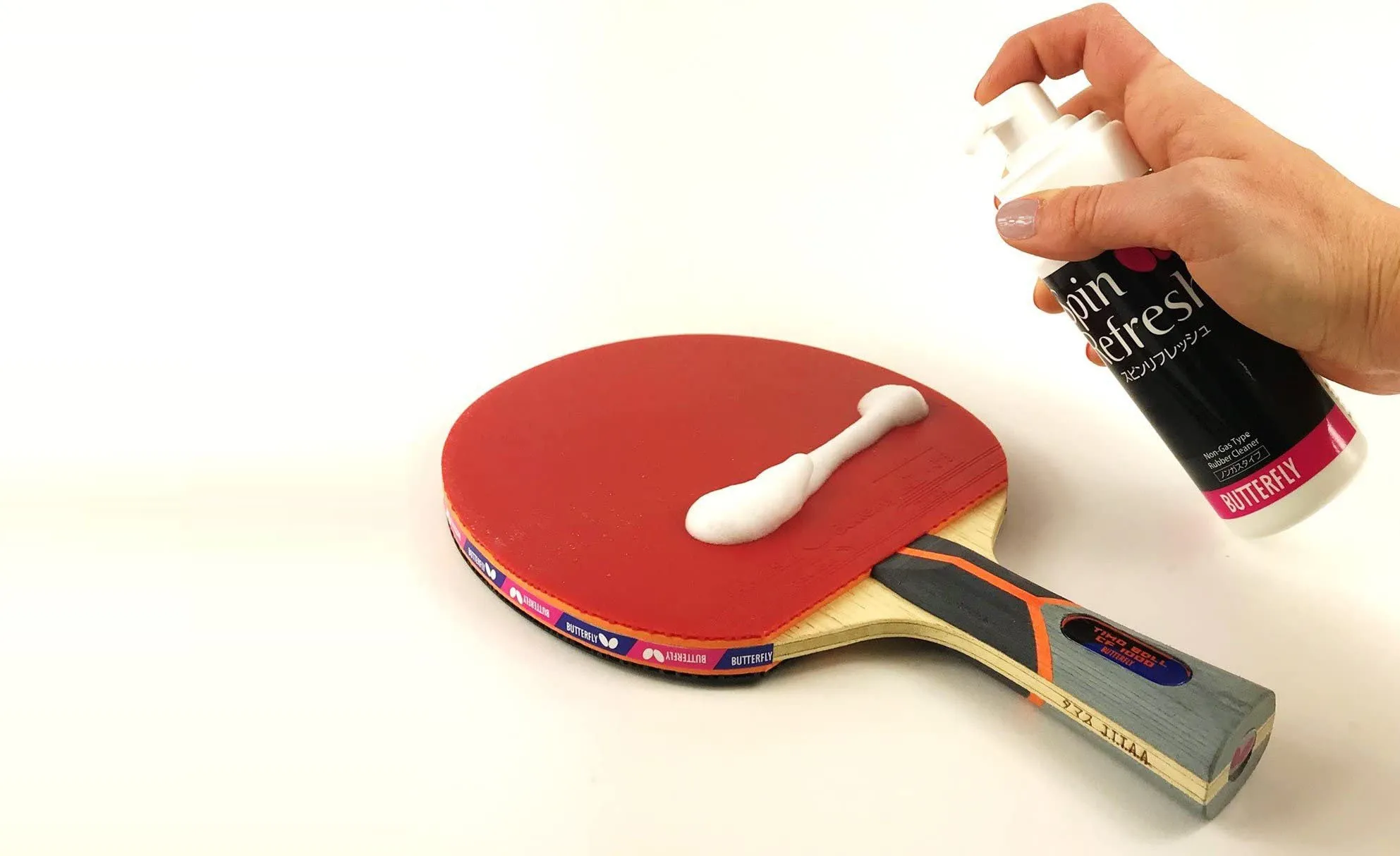
Clean the topsheet after every session with a proper rubber cleaner, not water, and the surface will hold its grip much longer. Store the racket with a cover on, away from direct heat. None of this restores worn sponge once the foam cells inside have collapsed, but it slows the clock considerably, and a slower clock means fewer wasted rackets and fewer mystery slumps that were never about your game at all. Most players replace their rubber far less often than they should, simply because nobody told them rubber and sponge have a shelf life measured in months, not years.
Does Sponge Work the Same Way on Pips and Anti-Spin Rubber?
Not exactly. Inverted rubber, the smooth black or red sheet most attacking and all-round players use, depends on sponge hardness almost as much as it depends on the topsheet, because the smooth surface needs the spring underneath to generate real pace.
Pips-out rubber behaves differently. The little raised pimples create speed and unpredictability on their own, through deflection rather than grip, so the sponge underneath matters less for spin and more for how much extra pop the rubber adds to an opponent’s shot. A defensive player running long pips often wants a thinner, softer sponge specifically because they don’t want extra speed added to a ball that’s already spinning in confusing ways. Adding power to an already chaotic shot just makes it chaotic and fast, which is rarely the goal for a defender trying to control the rally.
Anti-spin rubber takes this furthest. It’s built to absorb incoming spin almost entirely, and pairing it with a lively sponge defeats the entire purpose of the rubber. If you’re running anti-spin, a soft, slow sponge isn’t a compromise. It’s the whole point.
What About Speed Glue and Tuning?
Speed glue, which used to let players chemically boost sponge speed before a match, has been banned by the ITTF for years. Only ordinary water-based glue is legal now. Speed glue used to let players “tune” their sponge by swelling it chemically before a match, temporarily boosting speed beyond what the rubber was built for. The ITTF banned speed glue outright years ago, partly over health concerns from the volatile solvents involved, and partly because it made equipment performance unpredictable from match to match.
What’s left now is ordinary water-based glue, which bonds the rubber to the blade without altering the sponge’s properties. If a seller or a forum post is telling you about a “boost” technique that swells the sponge before play, that’s either describing an outdated and now-illegal method, or describing something that will get a tournament player disqualified on the spot. Buy the hardness you actually need. Don’t try to chemically cheat your way to a different one.
How Do You Choose the Right Sponge for Your Game?
Choose your sponge based on your swing, not the brand. A firmer sponge rewards a long looping stroke, while a softer sponge gives closer, quicker strokes more dwell time to control the ball. Start with your swing, not the brand. Choosing rubber and sponge separately, rather than accepting whatever a listing bundles together, is the difference between equipment that fits your game and equipment that fits nobody in particular. If you generate most of your power from a long, looping stroke with plenty of time before contact, a firmer sponge rewards that timing with real speed. If your strokes are shorter and quicker, closer to the table, a softer sponge gives you the dwell time to control the ball before it leaves.
Ask whether you play mostly offense or defense, because that single answer narrows the choice fast. Offensive players generally lean toward 40-45 hardness with thicker sponge. Defensive and all-round players generally do better in the low to mid 30s, prioritizing control and feel over raw speed.
If you’re still unsure where you fall, our free advisor at PingPath walks through your playing style and current equipment, then recommends a rubber and sponge combination that actually matches your swing instead of your favorite player’s swing. It takes less time than reading another forum thread, and it gives you a starting point grounded in your game, not someone else’s. Most rubber and sponge buying mistakes trace back to the same root cause: treating a two-part decision as if it only had one part.
You can find a wide range of rubber and sponge options to compare directly at Megaspin’s rubber selection, which lists sponge hardness alongside each topsheet so you’re not guessing at the second half of the decision.
How Do Premade Rackets Make the Rubber and Sponge Decision for You?
Premade rackets pick a soft, forgiving sponge hardness for you by default, which works fine until your technique outgrows it. Most beginner-level paddles sold as a single complete unit, blade and rubber already attached, skip this entire conversation. The manufacturer picked a sponge hardness for you, usually somewhere soft and forgiving, because a premade racket has to work reasonably well for a wide range of swing styles it knows nothing about.
That’s not a flaw. It’s a reasonable default for someone who hasn’t developed a consistent stroke yet. The problem shows up later, when a player’s technique improves and the premade sponge starts feeling slow and lifeless compared to what their swing can now generate. At that point, sticking with the same premade unit out of habit costs real progress, because the equipment stopped matching the player months ago and nobody noticed.
This is the exact moment to separate the decision into its two parts. Once you know your playing style well enough to describe it (offensive, defensive, close to the table, far from it) you’re ready to choose blade, rubber, and sponge as three independent pieces rather than accepting whatever combination came bundled together. It’s a bigger investment up front. It’s also the difference between equipment that holds you back and equipment that disappears entirely, which is what good equipment is supposed to do.
How Do You Read a Rubber Label Without Getting Fooled?
Look for a sponge hardness number, usually between 25 and 50, and check whether the listing separates sponge thickness from total thickness, since only sponge thickness actually changes the feel. Manufacturer listings bury the sponge hardness in different places depending on the brand, and some skip it entirely on the main product image, putting it only in a spec table further down the page. Look for a number, usually between 25 and 50, sometimes written as “sponge hardness” and sometimes just as “hardness.” If you can’t find it at all, that’s worth treating as a warning sign rather than an oversight, because a manufacturer confident in their product usually publishes the full spec sheet without making you dig for it.
Also check whether the listing separates “sponge thickness” from “total thickness.” Total thickness includes the topsheet, which is usually a fixed, thin measurement across most rubbers. Sponge thickness is the number that actually changes the feel, and confusing the two leads players to think they bought a thicker sponge than they actually did.
Frequently Asked Questions About Rubber and Sponge
Kyron switched to a softer sponge under the same topsheet two weeks later. The loops that used to die on contact started clearing the net with room to spare. He did not get better at table tennis that week. He just finally matched his equipment to the player he already was, which turns out to be most of the battle anyway.
Not sure your rubber and sponge actually match the blade underneath them? Run your setup through PingPath to get a pairing matched to your real game before you spend another dollar guessing.
Leave a Reply