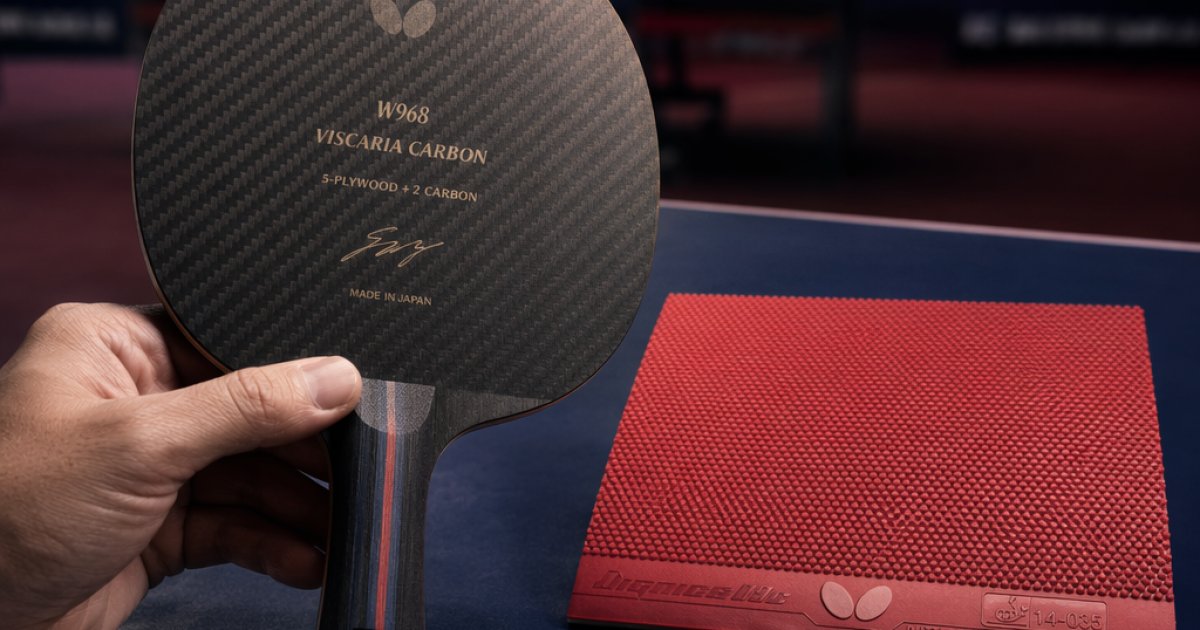
Josiah saved for three months to buy the exact setup Timo Boll uses, the ALC blade, Tenergy 05 on both sides, the same 2.1mm sponge, ordered down to the millimeter from a spec sheet he’d found on a forum, certain that the equipment itself was the missing piece between him and the players who’d started beating him at the club. He’d been playing eighteen months, mostly self-taught, with a decent forehand and a backhand that still broke down under real pressure.
The new racket arrived on a Thursday, and he’d told two clubmates about it before he’d even unboxed it. By that Sunday’s session, his loops were sailing long by a foot, his blocks were flying off the end of the table, and a clubmate who’d watched the whole thing shook his head and said the quiet part out loud: that blade wasn’t built for the swing Josiah actually had. It was built for a swing he might have in five years, if he kept playing that long.
What ping pong paddle do professionals use? It is public information, mostly, scattered across manufacturer pages, sponsor announcements, and forum posts nobody has bothered to organize in one place. What almost nobody tells you is that the equipment is only doing its job because of a swing that took a decade or more to build around it.
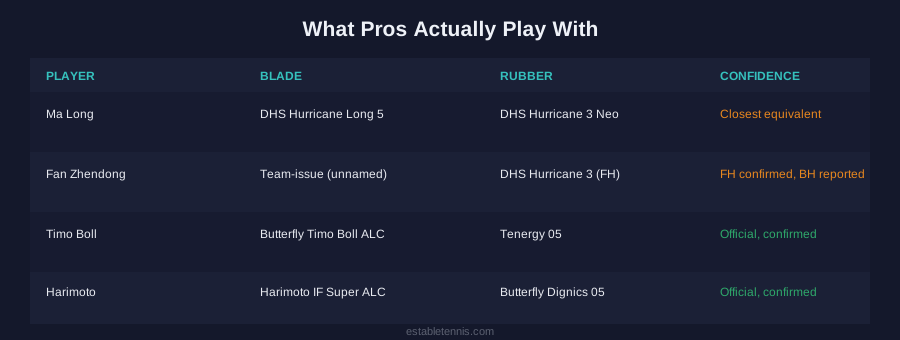
Top professionals use highly tuned, often team-issue equipment: Ma Long plays a DHS blade and Hurricane 3 Neo rubber, Fan Zhendong plays DHS Hurricane 3 on his forehand, Timo Boll plays the Butterfly Timo Boll ALC blade with Tenergy 05, and Tomokazu Harimoto plays a Harimoto Innerforce Super ALC blade with Butterfly Dignics 05.
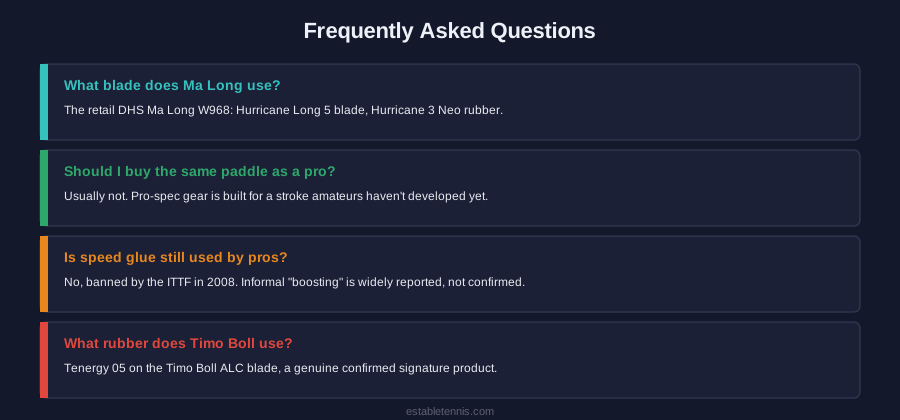
Buying the exact same gear rarely helps a club player, since pro equipment is tuned for swing speeds and consistency most amateurs haven’t built yet, and using it too early usually makes your results worse, not better. That is really the honest answer to what ping pong paddle do professionals use: gear tuned for someone else’s swing.
One more honest note before the breakdown below: equipment sponsorships and player choices do change over time, sometimes with little public notice until a new tournament broadcast or an updated manufacturer page reveals the switch. Treat everything in this post as an accurate snapshot researched at the time of writing, not a permanent fact carved in stone, and if you’re reading this a couple of seasons later, it’s worth a quick check on a player’s current sponsor page before assuming nothing has changed.
What Ping Pong Paddle Do Professionals Use, Player by Player?
Four real setups, checked against manufacturer pages and equipment trackers rather than guesswork, starting with the most decorated player on the list.
What Does Ma Long Actually Play With?
Ma Long’s official DHS-branded racket, the DHS Ma Long W968, sold under his own name and endorsed directly by DHS, pairs a DHS Hurricane Long 5 blade with DHS Hurricane 3 rubber (Neo versions are currently out of stock; the standard Hurricane 3 is the closest in-stock equivalent), 42° sponge on the forehand and a softer 37° on the backhand.
Worth being honest about one thing here: his actual match equipment is a customized, team-issue build, and the retail version sold under his name is described by DHS itself as the closest commercial equivalent, not an identical copy. That gap between tour equipment and what you can actually buy shows up across almost every top player, not just Ma Long.
What Does Fan Zhendong Actually Play With?
DHS Hurricane 3 Personal, 42° blue sponge, on his forehand, a detail that comes up consistently and without contradiction across every equipment-tracking site checked for this piece. His backhand is more often reported as a Butterfly Dignics 09C, which is worth flagging honestly rather than stating as settled fact, since a Chinese national team player using a non-domestic rubber on one wing is the kind of detail that circulates on forums and aggregator sites without a direct manufacturer confirmation behind it.
Treat the forehand pairing as solid and the backhand detail as commonly reported but not officially confirmed.
What Does Timo Boll Actually Play With?
Out of everything covered in this post, this one is the most solid, best-documented answer to what ping pong paddle do professionals use, the best-documented pairing on the entire list: the Butterfly Timo Boll ALC blade paired with Tenergy 05 rubber, documented directly on Butterfly’s own official shop pages as a genuine signature product, not an aggregator’s guess.
It’s also the pairing you’ll see recommended most often to intermediate and advanced amateurs looking for pro-level equipment, mostly because it’s real, well-documented, and Butterfly actually sells the exact combination rather than a “closest equivalent.”
What Does Tomokazu Harimoto Actually Play With?
Answering what ping pong paddle do professionals use for Harimoto specifically: he switched in October 2024 to the Harimoto Innerforce Super ALC blade, an upgrade from his previous standard Harimoto ALC, paired with Butterfly Dignics 05 on both sides. This is documented on Butterfly’s own player page, which makes it high confidence, and it’s a useful data point on its own: even a player who’s been on tour for years still changes equipment as his game evolves, which is worth remembering before assuming any pro’s current setup is a fixed, permanent choice.
Is Pro Equipment Actually the Same as What You Can Buy?
Close, but rarely identical. Beyond the team-issue versus retail gap already mentioned, there’s a real history here worth knowing: the ITTF banned VOC-based speed glue, phased in from January 2008 for juniors to a full ban that September, which means the last Olympic cycle played on legal speed glue was Beijing 2008. Speed glue used to let players re-tune a racket’s speed and elasticity before every match, and its disappearance genuinely changed the sport.
What replaced it, informally, is “boosting,” chemical tuning that multiple table-tennis-specialist sites report is widely believed to still happen at the elite level despite being against the rules, since it’s difficult to detect reliably under current testing. None of this is officially confirmed by any federation. It’s closer to an open secret than a documented fact, and it’s worth knowing about specifically so you don’t assume a retail rubber will behave identically to what you see on a tour broadcast.
Why Does Copying Pro Equipment Usually Backfire for Club Players?
Because pro blades and rubbers are built stiffer and faster than almost any club player’s swing actually needs, which is exactly what happened to Josiah. A blade tuned for a professional’s swing speed returns far more energy than a developing stroke puts into it, which means small technical errors get amplified instead of absorbed.
The same logic that applies to picking a blade suited to your own playing style applies here even more sharply: pro-spec gear typically retails for $150 to $220 for a blade and $60 to $100 per rubber sheet, real money to spend on equipment that’s actively working against a stroke that hasn’t caught up to it yet. If you’re at a stage where a genuine step up in equipment makes sense, a post like best table tennis paddle for intermediate players is a far more honest starting point than a pro’s signature blade.
None of this means equipment doesn’t matter at all for a club player, only that the specific pro-spec models named above usually aren’t the right vehicle for that improvement. The right question isn’t which blade a champion uses. It’s what your own current swing speed, grip, and playing style actually call for right now, which is a completely different question with a completely different, usually far cheaper, answer.
How Many Pros Actually Use the Same Brand?
Butterfly publishes its own annual survey of blade and rubber usage at World Championships, and the real, verifiable numbers are notable: 56.6% of competing players used a Butterfly blade at the 2019 World Championships, 53.2% used Butterfly rubber, and blade usage sat at 54.8% at the 2021 Houston Worlds.
Worth being precise about what this is and isn’t: it’s Butterfly’s own self-reported promotional data, not an independent or ITTF-run study, so treat it as directionally useful rather than neutral statistics. It does at least confirm something real: brand concentration at the very top of the sport is genuinely high, which is a different claim from saying any specific blade shape or material dominates.
It’s worth sitting with that Butterfly figure for a moment rather than skimming past it. More than half the field at a World Championship playing one manufacturer’s equipment is a genuinely large concentration for any competitive sport, and it says something real about trust built over decades of tour-level performance.
It doesn’t say a beginner or intermediate player should default to the same brand for the same reason. Brand trust at the elite level and equipment fit at the club level are simply answering different questions.
Does Equipment Explain Why Pros Look So Calm Under Pressure?
Partly, and it’s worth naming directly since it’s the piece most equipment breakdowns skip entirely. A professional’s racket produces the same result almost every time they execute the same stroke, which means their nervous system has years of consistent, reliable feedback to draw confidence from at 9-9 in the fifth.
That kind of mastery experience, proof from your own hands that a shot works under pressure, is a real input into staying composed, and it’s much harder to build on equipment that behaves unpredictably from one hit to the next. This doesn’t mean buying pro gear buys you pro composure. It means the two are connected in a way that’s easy to miss if you only think about equipment as a speed and spin question rather than a confidence one too.
Why Do Pros Switch Equipment Mid-Career at All?
Harimoto’s 2024 switch to the Super ALC blade is a useful example of something club players rarely see: even a player who’s been on tour since his early teens keeps adjusting equipment as his own game matures, his swing gets stronger, or a specific weakness needs a different tool to address it.
Manufacturers also release updated versions of signature blades and rubbers over time, and top players are often the first to test prototypes under real competitive conditions, sometimes for a full season, before a change gets made permanent and sold to the public under their name.
The lesson for a club player isn’t to chase every update a pro makes. It’s that equipment decisions aren’t supposed to be made once and locked in forever; at any level, they’re supposed to track the player’s actual game as it changes.
How Often Do Pros Actually Change Their Rubber?
Far more often than any club player would consider reasonable, which is another piece of the gap between tour equipment and retail reality worth knowing. Sponsored professionals typically have access to fresh rubber sheets on a schedule most amateurs would find wasteful, sometimes swapping a sheet every few matches or even between sessions at a major tournament, since a rubber’s grip and tackiness genuinely do fade with use and a sponsor’s whole job is making sure a player never competes on gear that’s past its best.
A club player replacing rubber every six months to a year is operating on a completely different budget and a completely different definition of “worn out” than a sponsored professional ever has to think about. A pro’s “worn out” often means a few days old. An amateur’s usually means most of a season.
Do Any Top Players Still Use Pure Wood Blades Instead of Carbon?
Yes, and it’s a genuine tactical choice rather than a sign of being behind the times. Carbon and arylate-carbon blades, the ALC family Timo Boll and Harimoto both use, add stiffness and speed that suit an attacking, loop-heavy game built around generating pace. Many top players, particularly those who rely more on placement, touch, and shot variation than raw power, still choose all-wood blades for the extra control and feel they provide, since a stiffer carbon blade can make the most delicate shots- a short push, a soft drop shot- harder to execute with precision.
Defensive specialists and choppers in particular tend to favor all-wood construction, often paired with long pips or anti-spin rubber rather than the fast inverted rubber an attacking player like Ma Long or Fan Zhendong uses, since their entire game is built around controlling spin and pace rather than generating it.
The takeaway is the same one that applies to club players choosing between a control-oriented blade and a speed-oriented one: the right choice depends entirely on the style of game you’re actually trying to play, not which material sounds more advanced.
Is There a Real Number on ALC Versus Wood Blade Usage Among Pros?
Worth addressing directly, since a specific figure, something like “28% of pros choose an arylate-carbon blade,” circulates on secondary equipment sites without a traceable source behind it. That number does not appear directly on Butterfly’s own published survey materials, and no independent breakdown of blade material by percentage across the pro tour turned up during research for this piece. The honest answer is that a clean, verifiable statistic on wood-versus-carbon usage doesn’t currently exist in public form, at least not one worth citing with confidence.
What does exist, Butterfly’s brand-share numbers cited above, measures something different: which manufacturer players use, not which blade construction. Anyone quoting a precise carbon-versus-wood percentage without naming where it actually comes from is very likely repeating a number nobody can trace back to a primary source, which is worth knowing before you repeat it yourself.
What Should You Actually Take Away From This as a Club Player?
Three things, and none of them is “buy what they’re using.” First, pro equipment is tuned for a swing speed and consistency most amateur players haven’t built yet, so the honest question isn’t which blade a champion uses; it’s what your own current stroke actually needs right now. Second, even the equipment you can genuinely buy, like the Timo Boll ALC and Tenergy 05 combination, is usually still too fast and unforgiving for a developing player, since “real signature product” and “appropriate for your level” are two separate questions with two separate answers.
Third, the equipment story behind any pro is more complicated than a spec sheet suggests, team-issue tuning, informal boosting, and mid-career switches all included, so treat “what does X play with” as interesting context rather than a shopping list.
Frequently Asked Questions
Josiah, three years later, still has the Timo Boll blade sitting in his equipment bag, the same question, what ping pong paddle do professionals use, no longer the one he’s asking. He just doesn’t play with it in matches anymore. It sits in the bottom of his bag as a reminder for whenever he’s tempted to skip a step again, and every so often a newer player at the club asks about it, having seen the name on a spec sheet somewhere online, and he gives them the same answer his clubmate gave him.
He went back to a racket built for the player he actually was that season, not the one he was hoping to become by that Sunday, and his results improved within a month in a way three months of saving for the wrong blade never managed.
If you want equipment fitted to your actual game instead of someone else’s, PingPath will get you there faster than a pro’s spec sheet ever will.
Leave a Reply