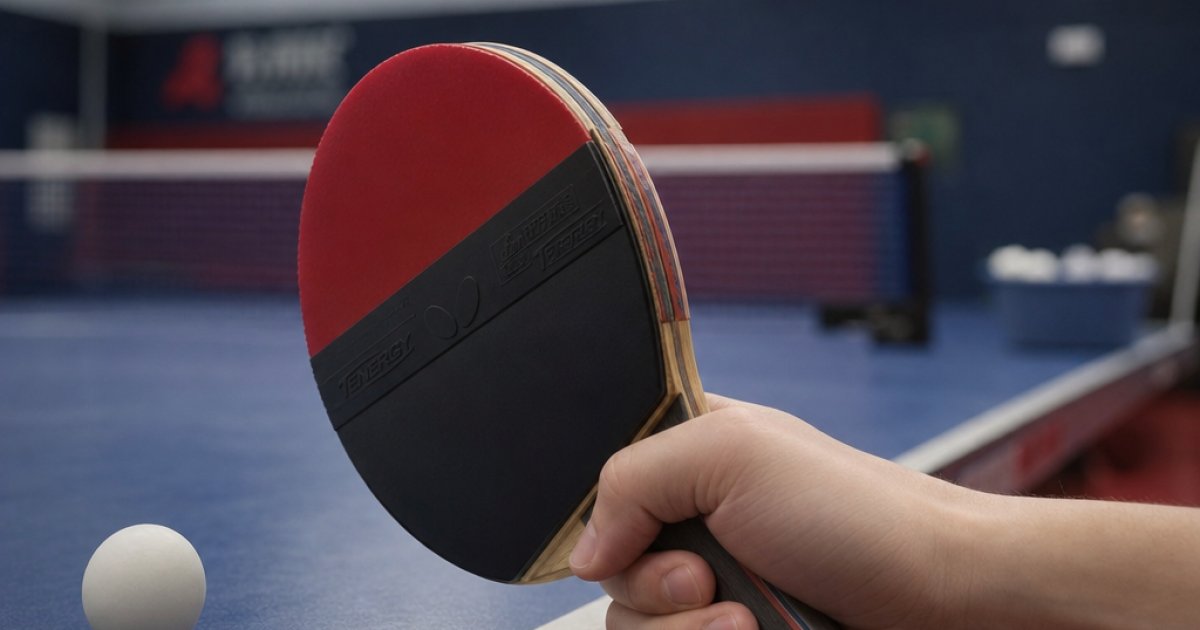
Aaron played three years at the community club in Point Fortin with the same fifteen-dollar set his aunt bought him the week he joined, the kind that comes in a cardboard sleeve with two paddles and a net you’re supposed to clip to any table. The sponge on both sides had gone shiny and slightly hard by the second year, the way cheap rubber does under humidity and sweat, and the wood underneath had that dull, dead knock when it met the ball instead of the sharper sound you hear off a proper blade. His footwork got good.
His reading of spin got good. His serve, a fast, low pendulum he’d built almost entirely by feel, got genuinely dangerous. And every single session, the same paddle that taught him the game quietly capped how far any of it could go, because rubber that thin and wood that soft has exactly one gear, and Aaron had long since outgrown it. His problem is the exact one the best table tennis paddle for intermediate players is built to solve.
Nobody at the club told him this directly, the way nobody ever quite does. He found out the way most intermediate players do, by noticing that two clubmates with worse footwork than him kept winning anyway, and eventually asking one of them to look at his paddle instead of his backhand.
The best table tennis paddle for intermediate players is a premade racket built with real carbon or ALC-blended wood and a mid-speed, mid-spin rubber already mounted, in the $100-$150 range, rather than a beginner box set or a bare pro blade you have to fit rubber to yourself.
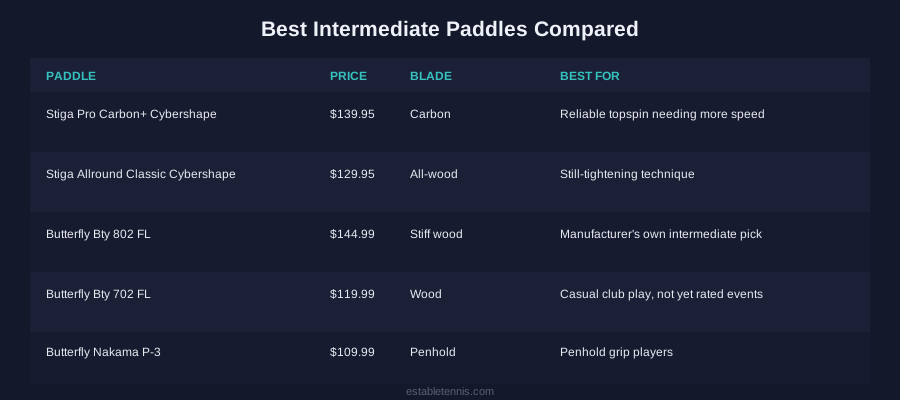
Five confirmed in-stock options that fit this gap are the Stiga Pro Carbon+ Cybershape, the Stiga Allround Classic Cybershape, the Butterfly Bty 802 FL, the Butterfly Bty 702 FL, and the Butterfly Nakama P-3 for penhold players.
How Do You Know You’ve Actually Outgrown a Beginner Paddle?
There are three honest signs, worth checking against your own game honestly before you spend anything, and Aaron had all of them without noticing. You can consistently produce topspin, and it still doesn’t clear the net with any real pace, because a beginner rubber’s sponge is too soft and slow to return the energy you’re now putting into the stroke.
You can read your opponent’s spin correctly but still mishit the return, because a hard, flat beginner blade gives you almost no feel for exactly how much the ball is gripping the surface. And you win rallies against players with worse technique than yours purely because their gear happens to fit their game better than yours fits your own. None of these are technique problems.
They’re ceiling problems, and no amount of extra practice raises a ceiling that’s built into the equipment itself.
What Actually Changes Between a Beginner Set and an Intermediate Racket?
Three things change, mainly, and each one is worth understanding on its own rather than taking on faith. The blade goes from solid, slow wood to a carbon-reinforced or all-wood-plus-composite build that returns more of the energy you put into a stroke instead of absorbing it.
The rubber goes from a thin, hard beginner sheet to a proper tournament-grade sheet with real sponge, usually in the 1.8mm-2.0mm range, that actually grips the ball long enough to generate spin rather than just deflecting it. And the whole racket gets noticeably lighter and better balanced for a reason: an intermediate player is starting to make real swing decisions mid-rally, and a heavy, poorly balanced paddle punishes hesitation far more than a light one does.
The 5 Best Table Tennis Paddles for Intermediate Players
1. Stiga Pro Carbon+ Cybershape
The Stiga Pro Carbon+ Cybershape ($139.95) is a carbon-fiber blade paired with a fast, grippy rubber already mounted and tuned to work together, which matters more than it sounds like it should. A carbon blade on its own, fitted with the wrong sponge, plays worse than a plain wood blade with the right one.
This combo is built by people who tested the pairing, not assembled by guesswork, and it rewards a player who has already developed a real topspin stroke and wants the paddle to stop absorbing the effort that stroke puts in.
2. Stiga Allround Classic Cybershape with Manta Control Rubber
The Stiga Allround Classic Cybershape combo ($129.95) takes the opposite approach from the Pro Carbon+: an all-wood blade for a softer, more controllable feel, paired with the Manta Control rubber built to forgive slightly mistimed shots rather than punish them.
This is the better pick for an intermediate player whose technique is still tightening up, someone who wants their equipment to help close the gap between a good stroke and a great one, rather than a player already producing reliable spin who just needs the gear to keep up.
3. Butterfly Bty 802 FL Racket Box Set
The Butterfly Bty 802 FL ($144.99) is Butterfly’s own answer to the exact question this post is asking, its product listing states plainly that it’s built for intermediate-level players, and it shows in the build: a stiffer blade than the entry-level Butterfly sets, with rubber fast enough to reward committed topspin without being so fast that a still-developing stroke gets punished for small timing errors.
If you want one racket recommended specifically for your skill level by the manufacturer, rather than one you have to reason your way into, this is it.
4. Butterfly Bty 702 FL Racket Box Set
The Butterfly Bty 702 FL ($119.99) sits one step below the 802 in speed and price, which makes it the honest choice for a player who’s outgrown beginner gear but isn’t yet playing enough tournament-style rallies to need the faster build.
It’s the paddle to buy if your matches are still mostly clubmates and casual competition rather than rated events, since the extra control at a slightly lower speed will cost you less in accuracy than the 802’s added pace would.
5. Butterfly Nakama P-3 (Penhold)
Almost every buying guide at this level assumes a shakehand grip and quietly leaves penhold players to translate the advice themselves. The Butterfly Nakama P-3 ($109.99) is a genuine Japanese-penhold-style racket, not a shakehand blade with a different handle bolted on, with rubber tuned for the shorter, quicker strokes penhold play actually uses.
If you play penhold and have been making do with a shakehand intermediate paddle turned sideways, this is the more honest upgrade.
Why Not Just Buy Another Budget Paddle Instead?
Because the math stops working in the budget tier’s favor once you’ve actually outgrown it. A twenty-dollar paddle from a post like best ping pong paddle under $50 is the right call for someone deciding whether they even like the sport, and a fine choice to keep as a spare or a loaner for a friend.
But buying a second, then a third budget paddle as each one starts to feel limiting costs more over two years than buying one intermediate racket once, and every one of those budget replacements still caps your game at the same ceiling the first one did. The upgrade isn’t really optional at this stage. It’s a question of whether you pay for it once or several times while getting the same result each time.
There’s also a feel difference that a spec sheet doesn’t fully capture. A budget paddle gives you almost no information back through your hand about how clean or mistimed a shot was, since the cheap sponge absorbs most of that feedback before it reaches you.
A properly built intermediate racket transmits enough of that feedback that you start to feel the difference between a shot that was slightly late and one that was clean, in the moment, which is exactly the kind of real-time information a developing player needs, and a beginner paddle simply can’t provide.
What Mistakes Do Intermediate Players Make When Upgrading?
The most common one is buying the fastest, most expensive blade available on the theory that more speed always means more improvement. It doesn’t. A carbon blade built for a player already producing consistent topspin will feel wild and unpredictable in the hands of someone whose stroke is still developing, because it amplifies small technical errors along with the good shots.
The second mistake is upgrading only the rubber and leaving a soft beginner blade underneath it, or the reverse, a carbon blade with a cheap rubber still attached. Both halves of the racket have to move up together, since a fast rubber on a dead blade, or a lively blade under a slow rubber, cancels out most of the benefit you paid for.
The third mistake is buying a bare, pro-level blade at this stage and assembling your own rubber combination without actually knowing how thickness and hardness interact with your swing speed, which is a real skill that takes real trial and error to build.
None of the five picks above ask you to have that skill yet. They arrive already matched, tested, and ready, which is exactly the point of an intermediate racket: it closes the gap between beginner gear and a full custom build without asking you to become an equipment technician first.
Does Handle Shape and Weight Matter as Much as Blade Speed?
More than most buying guides admit. Flared handles, marked FL, widen toward the head and suit a stronger, more locked-in grip, which is why four of the five picks above come in FL. Straight handles, marked ST, are thinner and popular with players who like to slide their grip slightly for different shots, and anatomic handles, marked AN, are shaped to fit the hand’s natural curve and tend to suit players who grip harder overall.
None of these is objectively better, and picking the wrong one for your hand does more to hurt your feel for the ball than a slightly wrong rubber choice would.
Weight matters too, and it’s worth checking before you buy rather than after. Most intermediate rackets in this price range land between 85 and 95 grams fully assembled. Lighter rackets suit a faster, more reactive style built around blocking and quick counters.
Heavier ones suit a player who commits fully to every topspin stroke and wants the extra mass carrying through the shot. If you’ve ever felt like your paddle was fighting your reaction time in fast exchanges, checking whether it’s simply too heavy for your hand is worth doing before you blame your footwork.
How Do You Choose the Best Table Tennis Paddle for Intermediate Players?
Grip comes first and isn’t negotiable here; the Nakama P-3 only makes real sense if you actually play penhold day to day. After that, it comes down to how much of your game is already reliable under pressure. If your topspin is consistent and you’re getting outplayed on speed, take the Pro Carbon+.
If your technique is still tightening up and mishits are still common, take the Allround Classic combo or the 702 FL, since both are built to forgive small timing errors rather than punish them. If you want the manufacturer’s own read on what an intermediate player needs and you’re already playing regularly at a club, the 802 FL is the straightest answer.
None of these five is a wrong choice for the level this post is written for. The differences between them are about which specific gap in your game you’re trying to close.
One more thing worth doing the day the racket arrives: check that the edge tape around the rubber is fully sealed and press the sheet down firmly across the whole surface, since a small air pocket near the edge will peel further with every hard hit and quietly change how the ball comes off that spot. Five minutes of care on day one adds real months to how long the rubber performs the way it did out of the box.
How Long Will One of These Paddles Actually Last You?
The blade itself, the wood or carbon core, will outlast almost everything else on the racket, often five years or more of regular club play, since it doesn’t degrade with use the way rubber does. The rubber is a different story. Expect the grip and tackiness of a mounted sheet to noticeably fade somewhere between six months and a year of regular use, faster if you play two or three times a week, slower if it’s closer to once.
When the rubber stops gripping the ball the way it did when it was new, and topspin starts feeling flatter without any change in your stroke, that’s the rubber telling you it’s done, not your technique regressing.
This is also the natural point where a lot of intermediate players graduate to a custom build rather than buying a second premade racket. By the time your first intermediate paddle’s rubber wears out, you’ll usually know a lot more about your own game than you did when you bought it, whether you want more speed, more control, a different feel on the backhand, and that specific knowledge is exactly what a custom blade-and-rubber combination needs to be worth the extra effort over simply buying another one of these five.
Should You Buy a Pre-Made Paddle or Build Your Own Blade-and-Rubber Combo?
A premade paddle, one of the five above, is the right call if you don’t yet know exactly what you want changed about your game and need equipment that stops holding you back. Building your own combo from a separate blade and rubber makes more sense once you have a specific complaint- too slow, too unpredictable, wrong feel on the backhand- that a generic combo can’t fix.
Most intermediate players are better served starting with a premade paddle from this list, playing it for a season, and only then chasing a custom build once they can describe precisely what they’d change.
If you’d rather skip the guesswork entirely, PingPath asks about your playing style and current gear and returns a fitted recommendation rather than a generic top-five list, which is worth running before you spend a hundred and forty dollars on a guess.
The ITTF’s equipment standards page is worth a quick check before buying anything, since not every rubber sold online is tournament-approved, and none of the five rackets above are worth much if you later find out they can’t be used in rated play.
Frequently Asked Questions
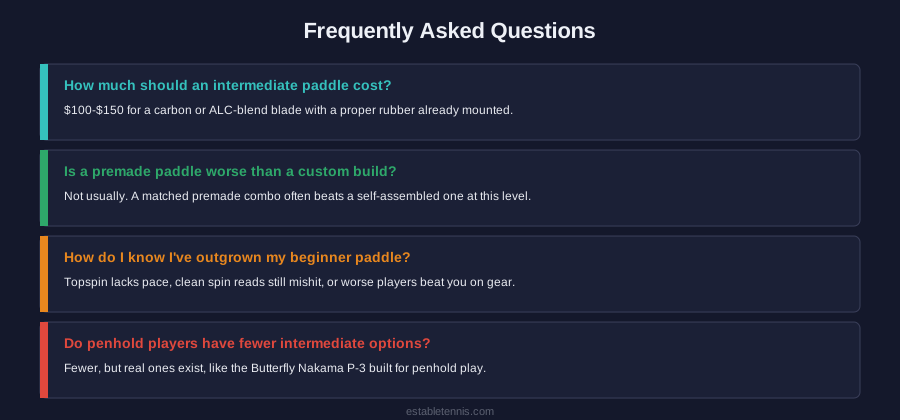
How much should an intermediate table tennis paddle cost?
Expect to spend $100-$150 for a premade racket with a carbon or ALC-blended blade and a proper tournament-grade rubber already mounted. Below that range, you’re usually still buying beginner-tier gear.
Is a premade paddle worse than building your own combo?
Not for most intermediate players. A well-matched premade combo often outperforms a self-assembled one, since the manufacturer has already tested the blade and rubber together. Custom builds make more sense once you have a specific complaint a premade set can’t fix.
How do I know if I’ve outgrown my beginner paddle?
Your topspin doesn’t clear the net with real pace, you mishit shots even when you read the spin correctly, or you lose to players with worse technique whose gear simply fits their game better than yours fits you.
Do intermediate penhold players have fewer options?
Fewer than shakehand players, but genuine options exist, like the Butterfly Nakama P-3, built specifically for penhold rather than a shakehand blade with a different handle.
Aaron switched to the 802 FL the same week his clubmate looked at his old paddle and laughed, not unkindly, the way you laugh at a photo of yourself from ten years ago. His footwork didn’t change. His reading of spin didn’t change. What changed was that his hands finally had a paddle capable of doing what his technique had already learned to ask of it.
Three months later, playing the same clubmate who’d laughed at him, he won a game for the first time in either of their memories, and neither of them mentioned the paddle once during the match. They didn’t need to. It had already done its job before the first serve.
If you’d rather get matched to the right paddle than guess from a list, PingPath will do it in under two minutes.
Leave a Reply