
Footage exists of Ma Long, minutes before a major final, sitting alone with his eyes closed while teammates and officials moved around him as if he weren’t there.
Nobody in that room needed to ask what he was doing. The stillness itself was the preparation, as deliberate and as practiced as any stroke he’d ever drilled on the table, and almost none of the commentary written about him that day mentioned it at all.
Beyond exceptional technical skill, Ma Long is distinguished by his mental composure under pressure, his all-round game combining offense and control, and his longevity at the top level across more than a decade of elite competition, including consecutive Olympic singles titles.
Most coverage of elite players fixates entirely on technique, when the actual separator at that level is almost always something quieter and considerably harder to film.
What does Ma Long’s playing style actually look like tactically?
An all-round offensive game built on exceptional consistency rather than reliance on any single dominant shot, covered in principle in our guide on offensive vs defensive style.
He’s equally comfortable attacking first or countering an opponent’s initial attack, which denies opponents an obvious tactical pattern to exploit the way a more one-dimensional style might.
How has Ma Long’s game evolved across his competitive career?
Early in his career, his game leaned more heavily on raw offensive power; over time, his tactical patience and shot selection matured considerably, adding layers of placement and disguise that made his already-strong technical foundation even harder to read.
This evolution reflects a broader truth about elite development: technical peak and tactical maturity don’t always arrive on the same timeline.
What’s known about his pre-match mental preparation specifically?
Publicly available footage and interviews suggest a consistent, ritualized pre-match routine emphasizing stillness and focus rather than physical warm-up alone, mirroring the broader mental composure principles covered across this site’s content.
This kind of deliberate psychological preparation rarely gets the same coverage as technical highlights, despite arguably contributing just as much to his sustained competitive success.
How does equipment factor into a player at Ma Long’s level, if at all?
Elite players’ equipment is meticulously fitted and maintained by dedicated support staff, representing the extreme end of the same equipment-fit principle covered throughout every guide on this site: at that level, gear is optimized to such a precise degree that it effectively disappears from conscious attention entirely, freeing complete focus for tactical execution.
What can a developing player actually learn from studying Ma Long’s matches?
Less about copying specific shots and more about observing shot selection patterns: when he chooses to attack versus counter, how he adjusts tactics against different opponent styles.
Slowed-down match footage reveals decision-making patterns that are considerably more transferable to a developing player’s own game than attempting to replicate his specific technical execution.
How has longevity at the elite level shaped his legacy differently than a shorter, more explosive career might have?
Sustained excellence across more than a decade demonstrates a different kind of mastery than a brief, spectacular peak: it requires continuously adapting to a changing competitive field, evolving equipment technology, and the physical demands of long-term elite training, all while maintaining the mental freshness that prevents burnout across years of pressure.
What does his career suggest about the relationship between mental and technical mastery at the highest level?
That neither one, alone, fully explains sustained elite success: the mental-equipment-technical crossover discussed throughout this site’s content isn’t a beginner-only concern that resolves with enough hours logged.
Even at the absolute top of the sport, composure and technical execution remain deeply intertwined, and the players who sustain excellence longest are rarely those who mastered only one half of that equation.
How does Ma Long’s approach connect to the mental-equipment crossover thesis that runs through this entire site?
His career is arguably the clearest possible illustration of it at the highest level: a player whose technical mastery is essentially unquestioned, and whose remaining edge over similarly skilled competitors comes down almost entirely to composure, equipment fit refined to an extreme precision, and tactical patience.
If the mental-equipment connection mattered only at beginner and intermediate levels, it should theoretically disappear at the very top. It doesn’t.
What’s a common misconception fans have about what separates elite players from merely very good ones?
That the gap is purely technical: faster loops, better footwork, more spin.
At the highest levels, technical differences between top competitors are often marginal, and the actual separator increasingly becomes composure under the specific pressure of a major final, tactical adjustment mid-match, and the accumulated small edges from equipment fit refined over years rather than months.
How should a developing player actually use a player like Ma Long as inspiration, rather than an unreachable standard?
Focus on the transferable principles: deliberate pre-match preparation, patient tactical evolution over years rather than expecting overnight mastery, equipment fit taken seriously rather than as an afterthought, rather than the specific outcomes, which depend on circumstances no developing player can replicate.
The process, not the trophy case, is what’s actually available to study and apply.
How does public coverage of Ma Long’s career typically get the emphasis wrong?
Highlight reels overwhelmingly favor explosive, visually dramatic shots (smashes, spectacular loops) over the quieter, more decisive moments that actually separate a match, like a tactical adjustment mid-game or a composed response to a lost point that could have spiraled.
This mirrors a pattern common across sports coverage generally: the visually exciting moment gets remembered, while the actual decisive factor often happens in a form that doesn’t translate well to a highlight clip.
What’s the honest takeaway for a fan who wants to genuinely understand what made his career last so long?
Watch full matches rather than highlight compilations, specifically paying attention to the points between the spectacular ones: how he resets after an error, how his tactical approach shifts across a match against a specific opponent’s adjustments.
That’s where the actual explanation for a decade-plus of sustained excellence lives, far more than in any single highlight-reel winner.
According to ITTF equipment regulations, elite competitors operate under exactly the same equipment approval standards as any club player, which is a useful reminder that the gap separating a player like Ma Long from the field was never about access to superior, unavailable technology: it was built entirely from years of composure, tactical patience, and fit refined within rules everyone plays under equally.
That stillness before a major final never made it into a single post-match interview question.
It simply happened, quietly, the way it apparently always did, and the results that followed spoke for themselves across more finals than most careers ever reach at all.
Composure like that isn’t a talent someone is simply born with. It’s a practiced skill, drilled with the same seriousness as a forehand loop, just never filmed with the same enthusiasm.
Every developing player watching those highlight reels has access to the same practiced discipline, whether or not a camera ever bothers to capture it.
Start with something smaller than an Olympic final. A club match, a practice session, the same closed-eyed stillness, tried once, just to feel what it actually does.
The trophy case is unreachable for most players. The stillness that helped build it is not.
That’s the one part of his career genuinely available to copy.
Worth trying before your next serious match, whatever level you’re actually playing at.
See what it does for you, closed eyes and all.
Simple as that, really.
Nobody’s watching yet. That’s exactly the right time to start.
Study the calm, not just the forehand. That is the actual Ma Long lesson.
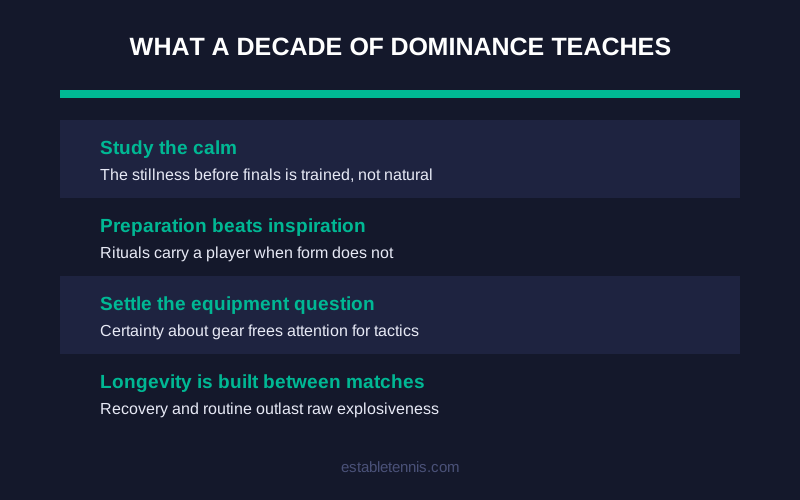
Quick Recap: Ma Long Table Tennis
Ma Long’s sustained dominance reflects technical mastery, but the actual separator across a decade-plus career was composure, tactical patience, and an equipment fit so precise it disappeared entirely from conscious attention.
That pre-match stillness, filmed but rarely discussed, was doing exactly as much work as anything visible in the match itself.
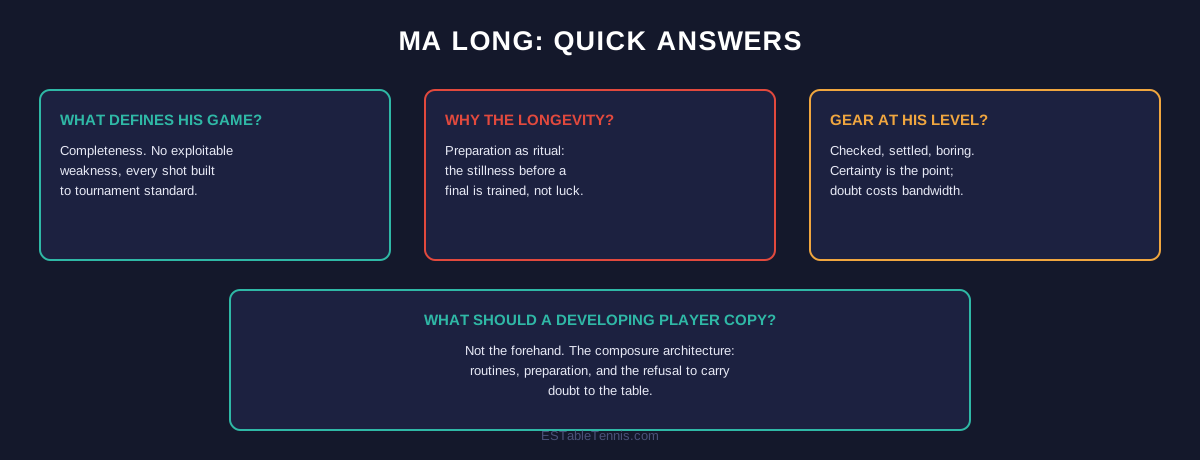
Frequently Asked Questions
What makes Ma Long’s playing style distinctive?
An all-round offensive game built on exceptional consistency, equally comfortable attacking first or countering, rather than reliance on any single dominant shot.
Does mental preparation really matter at the elite level, or is it all technique by that point?
Composure and mental preparation remain deeply important even at the highest level, since technical differences between top competitors are often marginal.
What can a developing player actually learn from watching his matches?
Shot selection patterns and tactical decision-making, which are more transferable than attempting to replicate specific technical execution.
How did his game change over his career?
Early power-focused play matured into greater tactical patience, placement, and disguise, adding layers beyond raw technical execution.
Nobody in that room ever explained what he was doing with his eyes closed. Nobody needed to. The result, across more than a decade, spoke plainly enough on its own.
Want to build the same kind of mental composure into your own pre-match routine? Check out the MentalEdge Course.
Featured photo: Ma Long at the 2013 World Championships in Paris, by Pierre-Yves Beaudouin, CC BY-SA 3.0, via Wikimedia Commons.
Leave a Reply