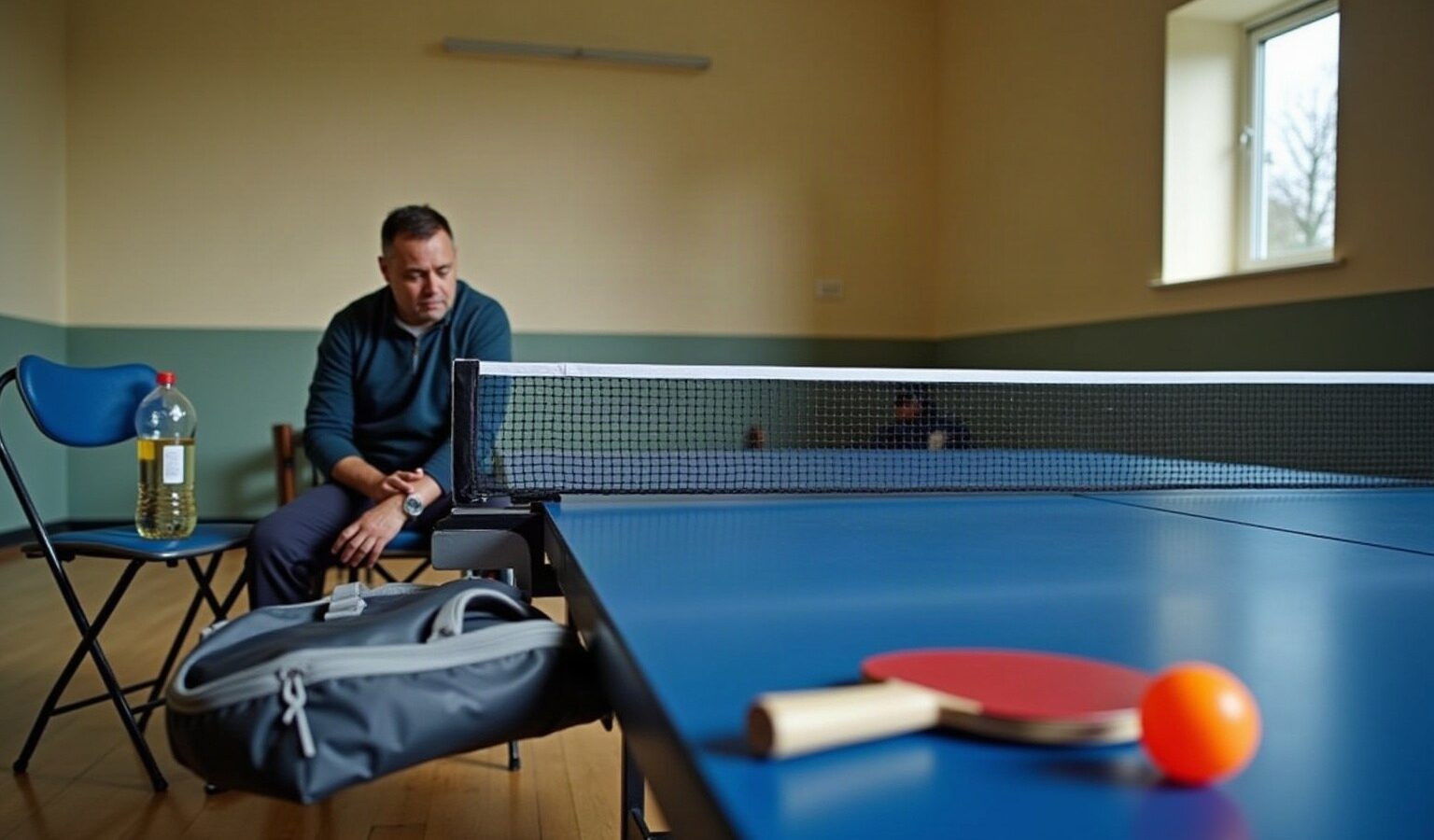
Picture a player sitting on the folding chair nearest the exit after club night. The hall is still noisy, but their table has been folded away. They put their bat into its case, zip the bag, then unzip it because their keys are underneath the towel. It is an ordinary end to an ordinary session, except that tonight they are thinking about quitting table tennis. Another close game has gone. The receive they practised appeared once, then disappeared when they wanted it most.
Someone passing the chair says, “See you next time.” They nod before they have decided whether that is true.
A disappointing score can become a surprisingly large verdict in the space between the table and the car park. The question is whether the verdict describes the sport you want to leave, the way you currently play it, or the way you judge yourself afterwards. Those deserve different answers.
Give the decision some space beyond the latest result. The urge to quit can reflect how you measure progress, especially when a scoreline becomes your only evidence, but it can also reflect tiredness, an unhappy playing environment or changed priorities. Look at results and skill separately, including what still needs work, then decide whether you want to continue, change how you play, take a break or leave.
Does Thinking About Quitting Table Tennis Mean You Should Stop?
It means something deserves attention, but the thought alone does not settle what you should do. You might be reacting to one painful evening. You might have been unhappy with playing for a while. You might still enjoy the sport but dislike league nights, the club atmosphere or the pressure you put on every result.
Start by describing the part you want to stop. “I want to stop losing to that player” is different from “I do not want to spend my evenings here.” So is “I cannot keep fitting this around work.” Give the reason its proper name before choosing an answer as broad as quitting.
You do not need to earn permission to leave by proving that you have suffered enough. Equally, having the thought does not oblige you to act on it. A decision can remain open while you work out what it is about.
The coaching approach in this article is to gather clearer evidence and make room for your preferences. It is not a test designed to produce the answer “keep playing” regardless of what you say.
Why Can a Losing Evening Feel Like Evidence Against the Whole Sport?
Because a result is easy to remember, while the details of your play take more effort to reconstruct. You know whether you won. You may need a moment to recall which serves you read correctly, which returns stayed short and which openings you avoided.
That difference can leave the score doing too much work. It records who won the match, then gets promoted to head of every other department: effort, improvement, belonging and whether the evening was worth leaving the house for. A scoreboard has a modest job. We can give it a very large office.
This is a possible pattern to check, not a diagnosis of everyone who wants to quit. A session can genuinely be unpleasant. Your technique can genuinely need work. Separating the evidence does not require you to discover a hidden victory inside every defeat.
Ask what the result actually establishes. You lost that match against that opponent under those conditions. It may reveal an important weakness. It does not, on its own, establish that you cannot learn, that you do not belong or that future sessions have nothing to offer.
What Are Five Honest Checks Before You Decide?
Check the result, the skill, the experience, the demands and your current priorities. These are coaching prompts, not a researched assessment or a scoring system. Their purpose is to stop one explanation crowding out the others.
- Result: What happened in the matches, and what specifically made those results painful?
- Skill: What could you do, what failed and what remains unclear?
- Experience: Did you enjoy any part of being there, or were you waiting for the session to finish?
- Demands: What did playing cost in time, energy and attention, and is that manageable?
- Priorities: Would you choose this commitment now if you were deciding afresh?
You may find mixed answers. You can like the people and dislike the competition. You can be improving and still want your evenings back. You can have a difficult run without wanting to surrender something that matters to you.
Do not turn the checks into another performance target. There is no passing score. The useful outcome is a more precise sentence: “I still want to play, but I want fewer competitive sessions,” or “I have other things I would rather do.”
How Do You Track Skill Separately From the Scoreline?
Keep the result and a short skill note beside each other, with neither allowed to erase the other. Choose one thing to observe before playing so you are not searching afterwards for whichever detail makes the evening look better.
Suppose your focus is receiving a short backspin serve. Your question might be: “When I recognised a short ball, did I use the controlled return I intended?” That is specific enough to discuss with a partner. “Did I play well?” invites the whole evening into an argument without defining the subject.
An illustrative session note might read:
- Result: Lost the practice match.
- Opportunity: Had chances to receive short backspin serves.
- What worked: Recognised some of those serves and kept some returns short.
- What missed: Pushed other returns long and misread a serve with less spin.
- Next question: Ask a partner to vary those serves and watch the contact.
Those are invented example observations, not a player’s reported results. In your own notes, record what you can remember honestly. If you cannot tell whether the serve had backspin, write that uncertainty down rather than giving yourself credit for reading it.
Use the same question again when the conditions make comparison sensible. A different opponent or a much faster serve changes the task. Notes from different situations can still be useful, but they do not automatically show improvement or decline.
What If the Skill Notes Show That You Are Still Struggling?
Then the notes have done their job. They have made the difficulty clearer without requiring you to feel cheerful about it. A useful record includes repeated errors, failed attempts and questions you cannot yet answer.
There is a difference between attempting the right shot and executing it well. Choosing to attack a suitable long serve may be a decision you wanted to practise. Missing that attack still tells you something about execution. Record both. Do not count every brave attempt as technical progress, and do not treat every miss as proof that attempting it was foolish.
You may discover that you need feedback rather than more determination. Ask a coach or a trusted club partner to watch the particular problem: “Can you look at why my return keeps going long?” That gives them something more useful than “Tell me whether I am any good.”
The guide to goal setting for table tennis players can help you turn a broad frustration into a target you can inspect. A goal should give practice a direction. It should not become a new reason to punish yourself when the learning is untidy.
How Do You Avoid Turning Progress Tracking Into Another Burden?
Keep the record small enough to serve your playing, and stop expanding it when it begins to dominate the evening. You do not need a report after every rally or a spreadsheet that requires more recovery than the match.
Choose one skill question and a brief note afterwards. If exact counts are useful and a willing partner can record them, agree on what counts before starting. Otherwise use plain descriptions and acknowledge that memory is incomplete. An approximate recollection should not dress itself as a precise measurement.
Avoid a rule that every session must contain a success. Some sessions may leave you with a clearer problem and little else. Others may be enjoyable without producing anything worth analysing. Both belong in a recreational sport.
You can also decide that tracking is not what you want from table tennis. If it makes a social evening feel like unpaid administration, leave it out. The point of examining your measurement is to give you a fairer view, not to require everyone to become their own full-time analyst.
What If You Still Want to Play but Have Lost Confidence?
Make the next playing task smaller and clearer, while keeping your expectations honest. Confidence does not require you to predict a win. You might simply want to approach a receive with a plan instead of apologising to yourself before the serve arrives.
For example, agree with a partner that you will practise recognising whether a serve is short or long, then choose an appropriate return. Keep that task separate from winning the practice game. You can judge whether you noticed the length and whether you followed your choice, including the occasions when you did neither.
The guide to building confidence in table tennis explores that side of playing. Treat confidence work as something you may choose because you still want the sport, rather than a prerequisite you must complete before being allowed to leave it.
If what you need is an evening without analysis, say so. “I would like to rally and enjoy playing today” is a valid request. Not every visit to the club has to carry the weight of your ambitions.
What If a Losing Streak Is Driving the Decision?
Look at the repeated pattern across matches, then decide whether you want to work on it. A losing streak can make the latest defeat feel like a replay rather than a separate event, but the practical response still depends on what is happening at the table.
Are the same serves causing trouble? Are you reaching close scores and changing your choices? Are you facing stronger opponents than before? Those possibilities point towards different practice questions. “I keep losing” is accurate if that is happening, but it is not yet a training instruction.
The guide to handling a losing streak in table tennis covers that narrower problem. Use it if recovering from the run is something you want. You do not have to solve every weakness before deciding that the current commitment is too much.
Keep the wider decision distinct from the next match. Winning once might bring relief without fixing an unhappy routine. Losing again might hurt without changing the reasons you still value playing. Neither result needs sole authority over whether you return.
How Can You Tell Whether the Playing Environment Needs to Change?
Describe what makes attending difficult and ask whether another arrangement would address it. The problem may be the kind of session available, how partners are chosen, the amount of waiting or the way people speak to you when you miss.
You might enjoy rallies but feel worn down by constant comparisons. You might want coaching and mostly receive unsolicited comments from whoever happens to be nearby. You might be comfortable competing but dislike the particular evening that currently fits your calendar.
A practical option is to ask about a different session, a quieter practice arrangement or a partner who wants to work on the same things. These are possibilities to explore, not promises that every club can accommodate them. You are allowed to decide that the available arrangement does not suit you.
If people make the environment unpleasant, do not translate that automatically into a flaw in your mental game. You can raise a concern with the organiser if you want to. You can also leave that setting. Enjoying table tennis does not commit you to enduring every place where it is played.
Is Taking a Break Different From Quitting?
Yes. A break leaves the next decision open, while quitting can mean you have decided to stop. You do not have to choose a permanent label if you are unsure, and you do not have to call it a break to make leaving acceptable to other people.
If a pause is what you want, make it practical. Let a partner or organiser know about any commitments you will miss. Decide whether you want club messages during the pause or would rather step away from them. You can set a review point if that helps, without promising yourself that you must return then.
During the break, notice what you actually miss and what you feel relieved to have removed. Perhaps you miss the rallies but not the league fixtures. Perhaps you miss the company. Perhaps you prefer having that time free. These observations can inform a decision without becoming another test you must pass.
A break is not a guaranteed route back to enthusiasm. It can clarify that you want to return differently, or that you do not want to return. Either discovery is useful if it helps you choose honestly.
What If Your Priorities Have Simply Changed?
Then changing your commitment may be the right decision even if your table tennis is improving. Progress does not create an obligation to keep pursuing it. A sport can have mattered to you without being entitled to the same place in your life forever.
Time already spent is not a debt that future evenings must repay. Nor do your clubmates need to agree that your new priorities are sufficiently impressive. You might have a clear competing commitment. You might simply want more unplanned time.
If you want to continue in a smaller way, consider what that would actually look like: occasional social play, fewer fixtures or practice without a competition target. Check whether that option exists and whether you want it. Do not accept a reduced commitment merely because it makes the announcement easier for someone else.
If you choose to stop, you can explain it plainly. “I am stepping away from playing because I want to use the time differently” is enough. You do not need to deliver a closing speech defending every match you ever played.
What Could You Do Before Your Next Decision?
Write down the reason you are thinking about quitting table tennis, then choose the smallest next step that fits that reason. This is a coaching suggestion, not a prescribed programme, and it does not require another session if you already know you want to stop.
If the score has swallowed everything else, separate the result from a skill observation. If a technical problem is making play miserable, ask for focused feedback. If the commitment is the problem, look at the calendar. If you need distance, take it.
When you review the decision, ask whether the change addressed what you actually disliked. Better receive practice will not resolve an evening you cannot afford in time. Fewer fixtures will not necessarily fix a playing environment you dread. Match the response to the reason, then let your answer remain honest.
Frequently Asked Questions
Is it normal to think about quitting table tennis after losing?
You can have that thought after a painful result without it deciding your future. Give yourself room to distinguish disappointment with the match from a lasting wish to stop playing. The thought deserves attention, not an automatic instruction to stay or leave.
Should I track wins if I want to enjoy table tennis again?
You can keep the results while recording skill separately. Include what worked, what failed and what remains uncertain so the notes do not become forced positivity. If tracking itself spoils your enjoyment, you can choose a less analytical way to play.
Will a break make me want to play again?
A break may help you understand what you miss, but it cannot guarantee renewed enthusiasm. You may want to return with a different commitment, or decide to stop. Both are legitimate outcomes.
Can I quit even if I am getting better?
Yes. Improving does not oblige you to keep giving the sport your time. Consider what you want from playing now, alongside your other priorities, rather than treating past effort as a reason you must continue.
Back to the folding chair beside the exit. The player can leave the bag zipped for a while, book another session or decide they have finished. The useful change is that the last missed receive no longer has to speak for every reason they came to the hall. A score can finish a match without finishing the conversation.
If you want support with the mental side of playing, try the MentalEdge Course, the mental game course for table tennis players, with a free 7-day trial and no card needed.
Leave a Reply