
Every 1500-rated player eventually asks the same question: what is the 1700-rated player across the table actually doing differently.
Two players in Chaguanas trained together for years, same coach, same drills, same hours logged on the same table, and yet one of them sits comfortably above 1700 while the other has spent three seasons stuck exactly at 1500, unable to explain the gap to anyone’s satisfaction, least of all his own.
Neither lacks technique. Watch them warm up side by side and you’d struggle to say which one is rated two hundred points higher. The gap only shows up once real points are actually on the line.
What separates a 1500-rated player from a 1700-rated player isn’t what most players think, and it isn’t technique at all.
If it’s not technique, what’s actually creating that two-hundred-point gap?
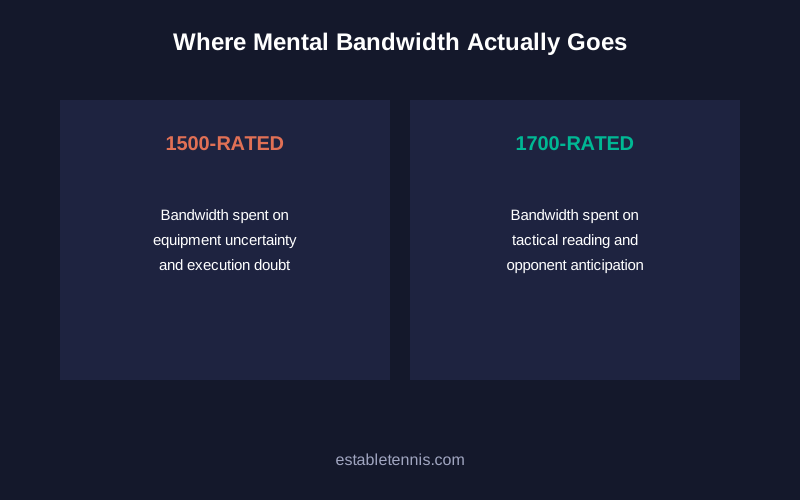
Cognitive load under pressure, mostly: specifically, how much mental bandwidth a player spends compensating for equipment and technical uncertainty versus how much is genuinely free to read the opponent and think tactically.
A 1700-rated player has internalized their equipment and fundamentals to the point where those variables have essentially disappeared from conscious attention, leaving their entire mental capacity available for the actual chess match happening point to point.
How does a 1500-rated player’s mental bandwidth get consumed differently?
A significant portion goes toward second-guessing contact, wondering whether a specific piece of equipment is actually suited to the shot being attempted, or simply managing basic execution uncertainty that a 1700-rated player resolved years earlier.
This isn’t a knowledge gap (both players might describe their technique identically in a conversation), it’s a gap in how automatic that technique has actually become under real competitive stress.
Does equipment mismatch specifically contribute to this stuck-at-1500 pattern?
Often, yes, more than players at that level typically suspect.
A setup that was never quite right for a player’s actual developing style, covered across our equipment guides on this site, forces exactly the kind of ongoing compensation that eats into the mental bandwidth a higher-rated player has already freed up.
The player stuck at 1500 isn’t necessarily working harder or smarter than the one at 1700: they’re simply spending real cognitive effort on a variable the other player resolved long ago.
Why doesn’t more raw practice time close this specific gap?
Because raw hours logged on mismatched or unresolved equipment simply reinforces the compensation pattern rather than eliminating it, covered in our piece on why most rubber recommendations online are wrong.
More practice on the wrong foundation produces a more deeply ingrained wrong foundation, not genuine progress past it.
How does a player actually identify whether this cognitive-load gap applies to them specifically?
Pay attention to what’s actually occupying conscious thought during a close, pressured point: if a meaningful portion of that attention is spent on basic execution uncertainty rather than pure tactical reading of the opponent, that’s the signal.
A player whose mental energy during pressure moments goes entirely toward outthinking the opponent, rather than managing their own uncertain technique, has already crossed the threshold this gap describes.
The truth is rarely pure and never simple, and this particular truth is uncomfortable precisely because it reframes years of stalled progress as a solvable, specific problem rather than a mysterious talent ceiling.
That player in Chaguanas, stuck at 1500 for three seasons, was never missing ability. He was simply spending it on the wrong thing, point after point, without ever being told exactly where it was actually going.
Curious whether an equipment mismatch is quietly consuming mental bandwidth you didn’t know you were spending? PingPath gives you a fitted recommendation in under three minutes.
The 1500-rated player is not missing talent. The 1500-rated player is missing bandwidth.
How does a 1500-rated player actually start closing this gap?
Start by honestly auditing whether current equipment genuinely matches actual playing style and swing speed, rather than assuming years of use automatically means it’s correctly fitted.
This audit alone often surfaces the exact compensation pattern that’s been quietly consuming mental bandwidth without ever being named or addressed directly.
Does this gap ever close purely through mental training, without touching equipment at all?
Partially: mental composure work, covered across our mental game content, meaningfully reduces the pressure-induced compensation that widens this gap during close matches.
But mental training alone doesn’t resolve a genuine equipment mismatch; it can only help a player manage the symptom while the underlying cause, if one exists, continues quietly consuming bandwidth every single point.
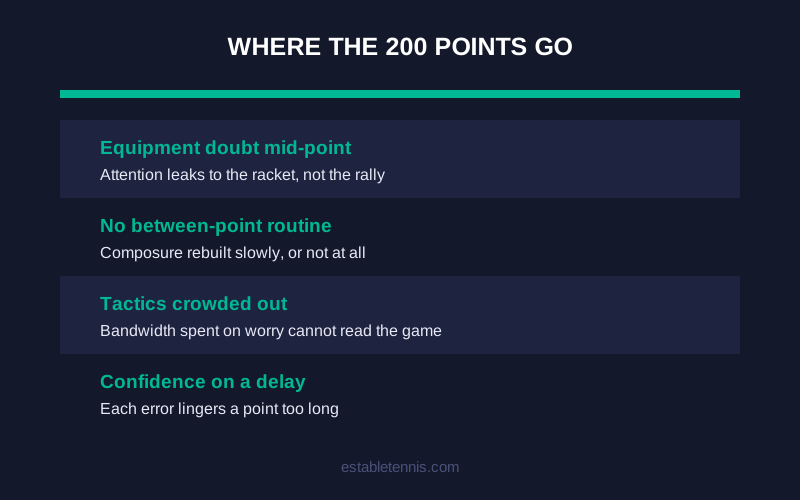
A 1700-rated player spends attention on tactics. A 1500-rated player spends it on doubt. Watch any stuck 1500-rated player between points and you can see the leak happening.
Why does this specific gap get misdiagnosed so often as a talent ceiling?
Because both players in a comparison like this one often look nearly identical during relaxed practice, which makes the actual difference (what happens specifically under real competitive pressure) invisible to casual observation.
A coach or teammate watching both players warm up has no way to see where each player’s mental bandwidth is actually being spent once real points start.
What’s the actual mechanism connecting equipment uncertainty to reduced tactical bandwidth?
Working memory is genuinely finite, and every fraction of a second spent unconsciously recalibrating for an unfamiliar or mismatched piece of equipment is a fraction of a second not spent reading an opponent’s shoulder rotation or anticipating their next placement.
This isn’t a metaphor: it’s a real, measurable competition for the same limited cognitive resource, and it compounds across every single point of a match rather than costing anything only once.
How does a 1700-rated player actually experience a match differently, moment to moment?
Time itself reportedly feels slower and more manageable, since less of it is being consumed by internal, unconscious equipment negotiation.
Players who’ve crossed this threshold often describe matches at their new level feeling less frantic than matches felt at their old level, despite the actual pace of play being objectively faster against stronger opposition: the extra mental space simply makes the same speed feel more workable.
Does this framework apply the same way at every rating range, or just around this specific 1500-to-1700 gap?
The underlying principle, freed-up cognitive bandwidth translating directly into tactical capacity, applies across most rating transitions, though the specific bottleneck consuming that bandwidth changes as a player advances.
Lower-rated gaps often trace back to basic contact and equipment uncertainty, the way this piece describes; higher-rated gaps increasingly trace back to more subtle tactical and psychological factors once the more foundational uncertainty has already been resolved.
The player stuck at 1500 in Chaguanas eventually did the equipment audit, almost as an afterthought, expecting it to reveal nothing significant.
It revealed a setup mismatched to his actual developing style for over two years, quietly explaining a gap he’d spent three seasons blaming on everything except the one variable that actually mattered.
Why does naming this specific mechanism matter more than simply telling a stuck player to “work harder”?
Because “work harder” assumes the bottleneck is effort, when the actual bottleneck is often where that effort is being unconsciously spent.
A player already training diligently, already logging real hours, doesn’t need more of the same input: they need a specific diagnostic reframing that reveals the actual leak, which no amount of additional generic effort would have surfaced on its own.
Two hundred rating points sounds like an enormous gap from the outside, the kind of distance that implies a fundamentally different level of ability.
Up close, sitting across the table from both players, it often looks like nothing more than one small, unresolved variable, quietly taxing one player’s attention every single point while the other player stopped thinking about it years ago.
Check your own bandwidth before assuming a rating ceiling reflects your actual ability.
It may only reflect where your attention has quietly been going all along.
The audit costs an afternoon. The three seasons it might save cost considerably more.
Two hundred points, it turns out, was never as far away as it felt from the outside.
Find out where yours actually went.
Start with the audit tonight.
See what it reveals.
You might be surprised by what’s actually there.
Worth the honest look.
Frequently Asked Questions
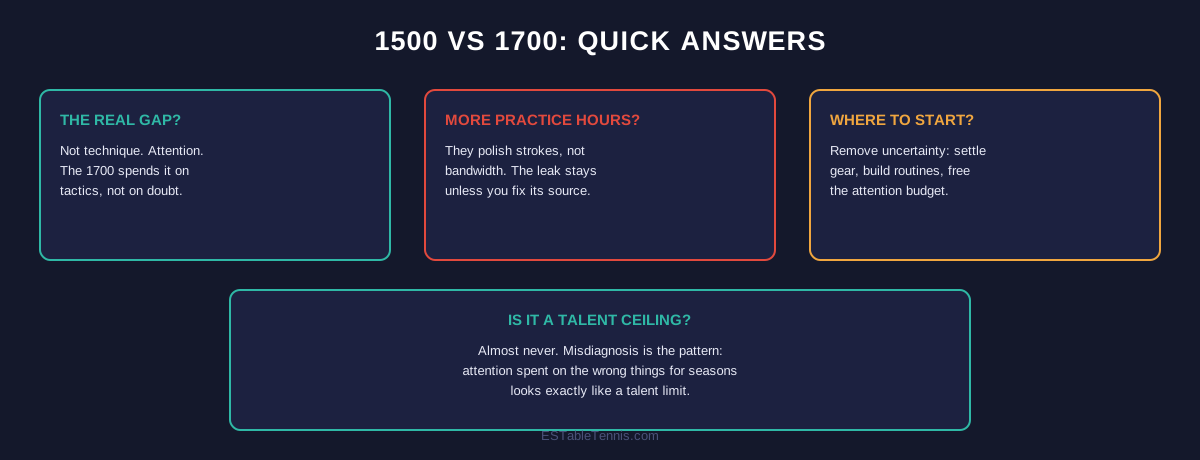
Is the gap between a 1500 and 1700-rated player really about equipment, not skill?
Can more practice hours close this specific gap on their own?
How do I know if this cognitive-load gap applies to my own game?
According to the ITTF equipment regulations, every legal setup meets the same baseline standard regardless of rating level, meaning the gap between 1500 and 1700 was never about access to better-approved gear: it was always about whether the gear a player already owns actually fits the game they’re trying to play.
Nobody ever tells a stuck player exactly where their missing two hundred points went. Most of them assume it was talent. Most of the time, it was simply attention, spent quietly on the wrong thing for three seasons running.
Leave a Reply