
There is a clip that circulates every so often in table tennis forums, grainy footage from a world championship warmup, showing Ma Long standing alone at the end of a table roughly forty minutes before a match that will be broadcast to hundreds of millions of people.
He is not stretching. He is not shadow-practicing his forehand loop. He is turning a rubber sheet over in his hands, pressing his thumb into the sponge near the edge, the way a jeweler checks a stone for a flaw only they would notice.
Nobody narrates this part. The commentary, when there is any, moves straight past it to the parts that look like sport: the first point, the fist pump, the towel.
What does Ma Long’s pre-match routine actually reveal?
Ma Long’s pre-match routine reveals that elite preparation is built around equipment familiarity, not just mental visualization.
He handles his rubber and blade in the same deliberate sequence before every match specifically to remove equipment uncertainty from his attention, so that his mental focus during the match goes entirely to the opponent rather than to his own gear.
That distinction matters more than it sounds like it should, because the entire mental-training industry around table tennis, the visualization scripts, the breathing protocols, the pre-point rituals, is built on an assumption that never gets said out loud: that the equipment is a fixed, trusted variable, and the only thing left to manage is the mind.
For a player at Ma Long’s level, that assumption is true, because he has already done the work most recreational players skip entirely. For everyone else, it is exactly backwards.
Why Does Ma Long Check His Rubber Before Every Match?
He checks his rubber before every match because tacky inverted rubber changes in performance with temperature, humidity, and the number of times it has contacted a ball since the last cleaning, and a top player treats any of those changes as a variable worth eliminating before it can cost a point.
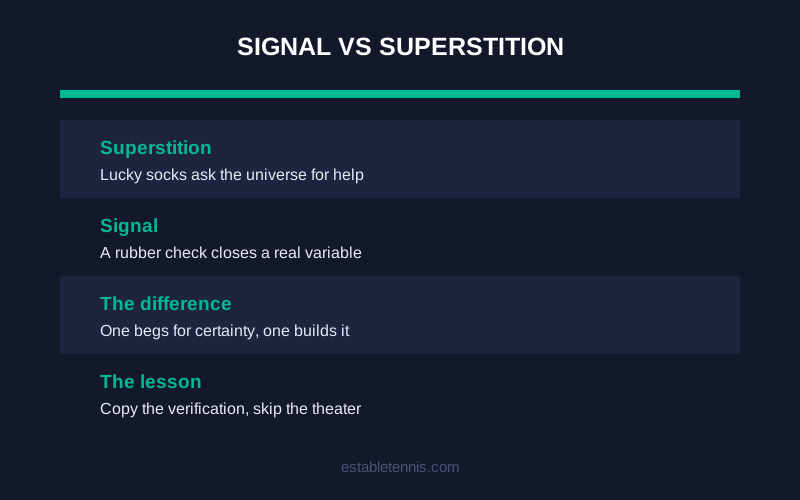
This is not superstition dressed up as ritual. Rubber grip genuinely degrades with dust, oil from fingers, and ambient humidity, and the difference between fresh tack and dulled tack changes how much a loop actually bites the ball.
A player who has internalized this checks it the way a pilot checks instruments before takeoff, not because something is probably wrong, but because checking is cheaper than being wrong mid-match.
Recreational players almost never do this. Most club-level players glue a sheet of rubber on, play with it for months, and never handle it with any intention beyond wiping it down. The rubber is not a variable to them. It is furniture. That’s the gap.
What Does Elite Equipment Preparation Actually Look Like?
It looks like removing every source of doubt about the paddle before the doubt has a chance to show up as hesitation on a shot.
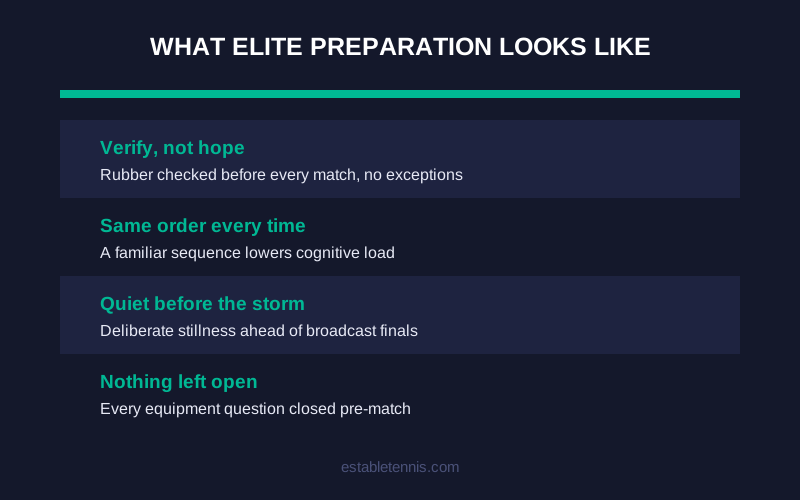
Elite players and their coaches spend hours pairing blade and rubber combinations to a specific playing style long before a tournament, then treat the pre-match handling as a final confirmation that nothing has shifted, not a discovery process.
The confirmation is quick because the real work already happened weeks earlier.
Contrast that with the typical recreational path: buy a pre-made racket because it was recommended in a roundup article, never test it against an alternative, and carry a low-grade uncertainty about the equipment into every single match without ever naming it as uncertainty.
It just feels like nerves. It is often something more specific than nerves.
How Does Equipment Uncertainty Show Up as a Mental Problem?
It shows up as hesitation on shots that should be automatic, because a small unconscious part of attention is spent monitoring whether the equipment will do what the player expects rather than trusting it completely.
Sports psychology research on attentional focus consistently finds that skilled motor performance depends on automaticity, meaning the body executes a well-learned movement without conscious monitoring interrupting it.
When a player doesn’t fully trust their equipment, that monitoring process gets triggered on shots where it has no business being active, and the shot suffers exactly the way a memorized speech suffers when the speaker starts thinking about their own voice mid-sentence.
This is the real content of what Ma Long is doing in that warmup footage. He is pre-emptively closing the door on a source of in-match doubt that most players never even identify as a door.
Why Doesn’t Mainstream Coverage Ever Mention This?
Mainstream coverage doesn’t mention it because it isn’t visually interesting and it doesn’t fit the narrative arc a broadcast needs.
A camera can show a rally, a smash, a scoreline. It struggles to show forty minutes of quiet equipment confirmation that happened in a practice hall before anyone with a microphone arrived.
So the footage that exists is almost accidental, caught by a fan with a phone or a federation’s behind-the-scenes reel, and it never gets contextualized as anything more than a curiosity.
Nobody frames it as the actual mechanism behind the composure everyone praises Ma Long for in interviews.
That’s a shame, because it’s the more useful story. “Stay calm under pressure” is advice with nowhere to go. “Remove the variables you can control before the ones you can’t control show up” is advice a person can actually act on this week.
What Should a Club Player Take From This, Practically?
A club player should take from this that the pre-match ritual worth copying isn’t the hand movement, it’s the underlying discipline: know your equipment so completely that checking it becomes confirmation rather than diagnosis.
That means playing enough matches and practice sessions with the same rubber and blade combination that you’d notice immediately if something felt off, rather than discovering a problem mid-game and not being able to tell whether it’s the equipment, the nerves, or the opponent.
Most players never get there because they change equipment too often, chasing whatever a forum thread praised that month, which means they never build the baseline familiarity that makes a thirty-second check meaningful.
Consistency of gear, not frequency of upgrades, is what buys you the mental quiet Ma Long is operating in in that footage.
None of this requires expensive gear. It requires the same combination for long enough that your hands know it better than your eyes do, so that on the day it matters, checking is just checking, not gambling.
That’s the whole trick, if it can even be called one: certainty bought early, spent quietly, forty minutes before anyone is watching.
Ma Long’s pre-match routine isn’t complicated, and that’s exactly the point: it’s a short, repeatable check, not a ritual for its own sake.
Any player can build a version of Ma Long’s pre-match routine around their own equipment, and the payoff shows up before the first point is even played.
A pre-match routine is not superstition. A pre-match routine is an attention budget, spent before the first point instead of during it.
Quick Recap: Ma Long’s Pre-Match Routine
Elite pre-match routines are built around confirming, not discovering, equipment trust.
Rubber and blade familiarity gets established weeks before a tournament, and the on-court ritual is a final check, not a search for problems.
Recreational players skip the establishing phase entirely and carry unnamed equipment doubt into matches as generic nerves, which then surfaces as hesitation on shots that should be automatic.
Frequently Asked Questions
What does Ma Long do before a match?
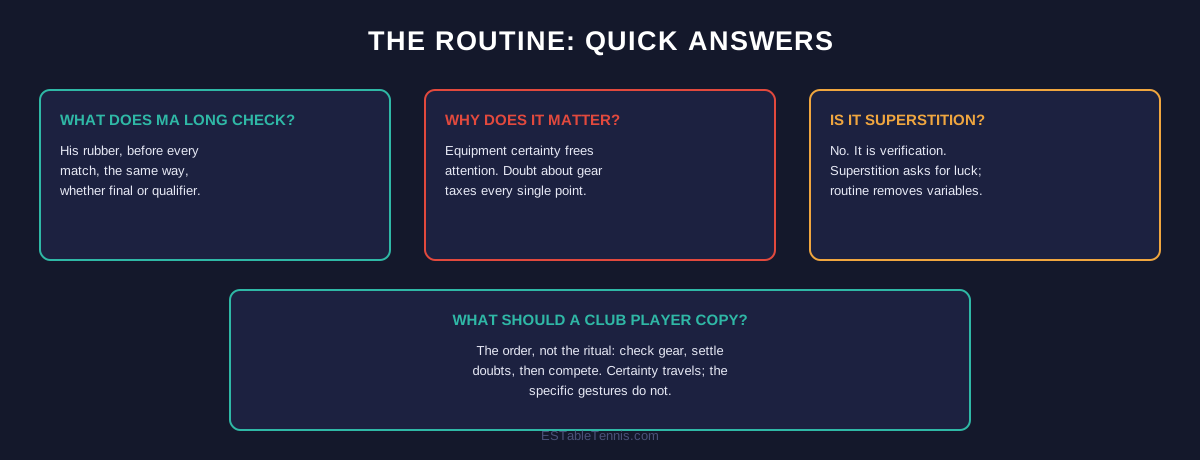
Before a match, Ma Long handles his rubber and blade in a deliberate, unhurried sequence to confirm the equipment feels the way it did in training, closing off any lingering doubt about his gear before he steps to the table.
Why do rubber sheets change how a paddle performs?
Rubber sheets change performance because tack and grip degrade with humidity, temperature, dust, and skin oil, which alters how much a shot bites the ball even when the sheet looks visually unchanged.
Can equipment doubt actually affect performance under pressure?
Yes. Equipment doubt pulls a sliver of attention away from automatic execution and into conscious monitoring, and that monitoring is enough to disrupt shots that depend on the body acting without interference from the mind.
How can a recreational player build the same equipment trust as a pro?
By testing rubber and blade combinations deliberately against their own playing style well before a match, instead of relying on a generic recommendation, so that equipment confidence is established in practice and only needs confirming on match day.
The truth is rarely pure and never simple, and it’s certainly not as simple as “visualize success” or “trust your training,” the two phrases printed on more mental-game worksheets than anyone has bothered to count.
Ma Long’s thumb pressed into a rubber sheet forty minutes before a world championship match is not a superstition. It’s a man closing a door so quietly that nobody watching even notices it was open.
If you want your own game to carry less unnamed doubt into the moments that matter, start where he starts, not with the mind, but with the thing in your hand.
MentalEdge Course builds the mental training on the assumption that your equipment already earned your trust; make sure that assumption is true first.
Research on attentional focus and skill execution under pressure is documented extensively in the sport psychology literature; see the International Table Tennis Federation for equipment regulation standards referenced throughout this piece.
Leave a Reply