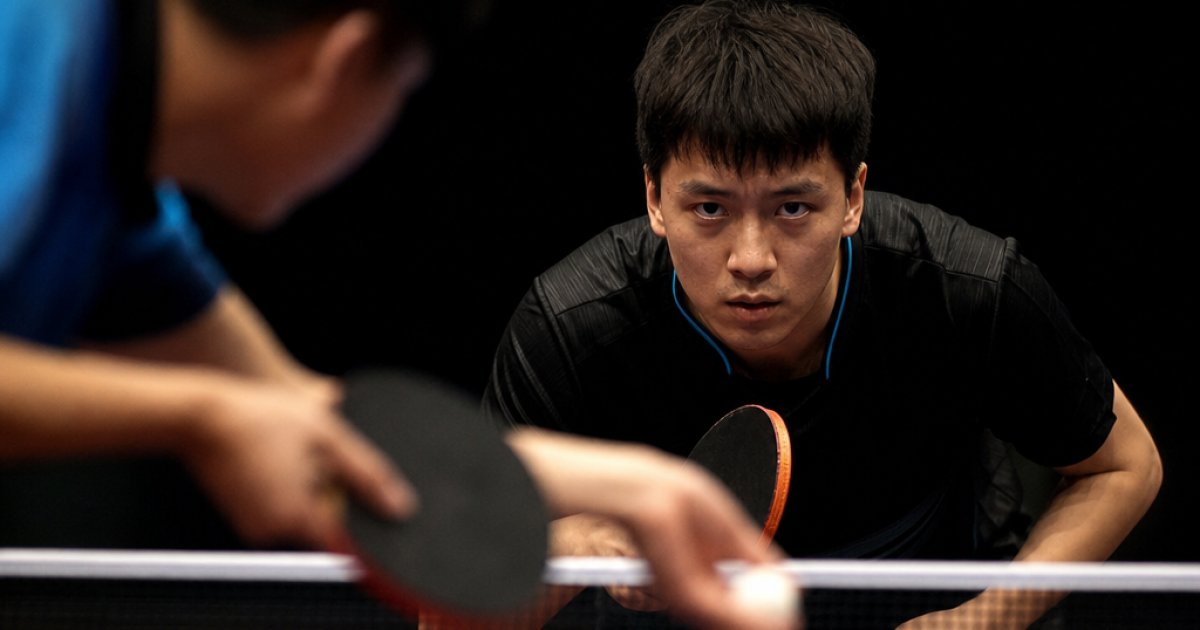
Good players do not react to the ball. They react to everything the opponent does before the ball, the toss, the grip shift, the last half-second of backswing, and by the time the ball actually leaves the racket, they have usually already decided what they are going to do about it. Track it. Do not just notice it once and move on.
This is not a gift some players are born with. It is a specific, studied skill, and it can be built the same way a stroke can.
None of this means abandoning the ball entirely as information. The ball still confirms what you predicted or corrects you when you’re wrong, which is exactly the feedback loop that improves the read over time. The point is not to stop watching the ball. It is to stop waiting for it before you start deciding.
Reading your opponent in table tennis means using pre-contact cues (grip changes, toss height, backswing angle, contact point) to anticipate spin and direction before the ball arrives, rather than reacting to the ball’s flight after the fact, which is simply too late against a fast, well-placed shot.
What Does “Reading Your Opponent” Actually Mean, Scientifically?
It means anticipating an opponent’s shot using cues available before contact, not reacting to the ball’s flight after it leaves the racket, and this distinction is what separates expert perception from novice perception in the actual research.
A 2019 study on expert table tennis players found that skilled players process an opponent’s action at two levels simultaneously: the concrete, motor-kinematic level (the actual movement) and a more abstract, conceptual level, activating brain regions associated with semantic processing rather than relying purely on movement cues.
In practice, this means an expert is not just watching the racket. They are recognizing the whole situation as a pattern they have seen before; table tennis is just the game where the recognition has to happen the fastest. Both moved. Only one was actually seen.
Bruce Abernethy’s earlier, classic research on advanced cue use in squash found the same underlying principle in a related racket sport: experts extract usable information from an opponent’s pre-contact movement that novices simply do not notice is there. The cue was always visible. Only one player had learned to see it. Only one player had learned to look for it in the first place.
What Physical Cues Predict a Serve?
Watch the toss height, the grip at contact, and the angle of the racket face in the last moment before the ball is struck, since these three cues, more than anything about the ball itself, predict what kind of serve is coming.
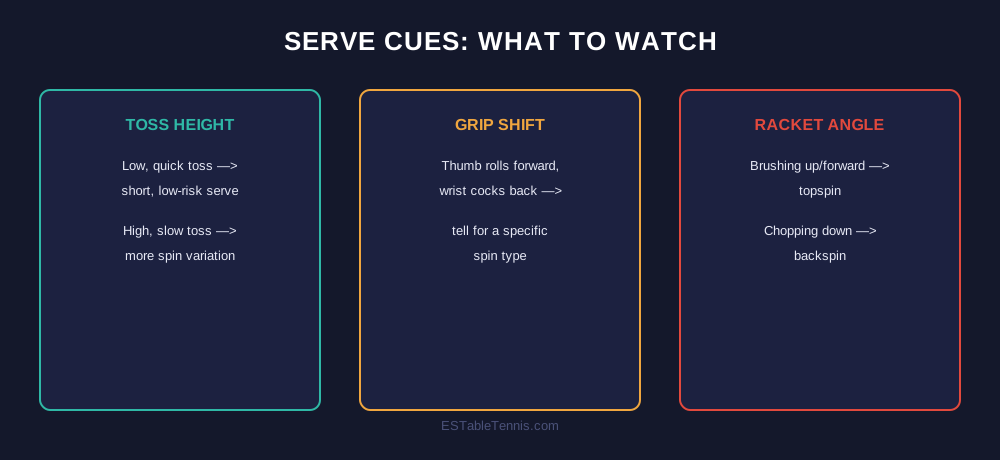
A low, quick toss usually signals a short, low-risk serve. A higher toss with a longer pause often precedes a serve with more spin variation, since the extra time gives the server room to disguise a more complex racket motion. A grip that shifts slightly before contact, thumb rolling forward, wrist cocking back, is frequently a tell for a specific spin the player has not learned to fully disguise yet. None of these are universal. Each opponent has their own version, which is exactly why the next section matters as much as this one.
How Do You Read Shot Direction Before the Ball Arrives?
Watch the shoulder rotation and the angle of the racket a fraction of a second before contact, since these predict direction more reliably than trying to track the ball itself once it is already moving at full speed.
A player committing to a cross-court shot typically opens their shoulders and hips slightly earlier than one going down the line, and this rotation is visible before the racket even makes contact. This is the same principle behind reading a serve, extended to the rally: the ball’s actual flight is the last and least useful piece of information you will get, because by the time you are reacting to it, a fast shot has already used up most of the time you had to respond.
The rally never slows down to let you think. The only real option is arriving already knowing, before it starts, which is what all of this training actually buys you.
How Do You Read Spin Specifically, Not Just Shot Direction?
Watch the angle of the racket face relative to its path through contact: brushing up and forward signals topspin, a chopping motion downward signals backspin, and a flat, glancing angle with minimal brush usually means limited spin either way.
The sound of contact is a secondary cue worth training your ear for as well. A sharp, clean crack tends to accompany a flatter, faster shot with less spin. A softer, brushing sound usually means more spin and comparatively less raw speed.
This is a cue most players never consciously notice they could be using, since it does not require watching anything at all, only listening, which frees up your eyes to track body position and racket angle at the same time. A wrist that stays perfectly loose right up until the last instant almost always means more spin is coming than the racket path alone would suggest.
Reading spin matters more than reading direction in most rallies, because a misread on spin causes a technical error (the ball goes into the net or off the end) even when your positioning was otherwise correct, while a misread on direction usually just costs you a step of recovery time.
Prioritize spin-reading first if you can only train one of the two deliberately. A misread that costs you a step of positioning is usually recoverable. A misread on spin usually is not.
How Do You Read an Opponent’s Tendencies Over a Whole Match, Not Just One Shot?
Track patterns tied to specific situations, what they do on game point, what they do after they have just lost a point, what they serve when they are nervous, rather than only reading individual shots in isolation.
Most players have a default under pressure, a safe serve they return to at 9-9, a shot they avoid after missing it once. These patterns are usually more reliable than any single pre-contact cue, because they are less about physical tells and more about a player’s psychology repeating itself under similar stress.
If you noticed your opponent served the same safe, short serve at deuce in game two, there is a real chance the same serve shows up at deuce in game four, regardless of what their toss height happens to look like that specific point.
Does Reading Your Opponent Work Differently Against Different Playing Styles?
Yes. Aggressive attacking players tend to telegraph more through backswing size and shoulder commitment, since generating power requires a bigger, more visible motion, while defensive and chopper-style players often give away less through gross body movement and more through subtle changes in racket angle and contact timing. Bigger movement, bigger information, right up until the ball actually leaves the racket.
Against a hard attacker, the cues tend to be larger and easier to spot once you know to look; the whole body commits earlier to a big shot. Against a defensive chopper, the tells are smaller and more subtle, often limited to a slight wrist adjustment that changes backspin intensity without any dramatic change in body position.
This is part of why the same general reading skill takes longer to sharpen against defensive specialists specifically; the raw amount of visible information is simply smaller.
Should You Watch Your Opponent’s Eyes as Well as Their Racket?
It can help, particularly for reading serve placement, since some players unconsciously glance toward their intended target a fraction of a second before serving, though this tell is inconsistent and disappears quickly in more experienced competitive players who have learned to control it.
Treat eye direction as a bonus cue to check for early in a match, not a primary tool to rely on, since it is one of the first tells competitive players train themselves out of once a coach points it out. Racket angle, toss height, and grip shift are more durable cues that persist even in experienced players, because they are mechanically tied to producing the shot itself rather than being a separate, correctable habit.
A grip that changes mid-motion is far harder to fake convincingly than a glance, which is exactly why it survives as a tell long after the eyes stop giving anything away.
Can You Train This Skill, or Is It Only Natural Talent?
It is trainable, and the research on expert-novice differences in anticipation is specifically about a learned perceptual skill, not an innate gift some players simply have, and others do not.
Watching match footage, your own and other players’, with the specific goal of predicting the next shot before it happens, then checking whether you were right, is a direct way to train this. Pause the footage right before contact, make your prediction, then watch the outcome.
A specific drill worth running with a training partner: have them serve or feed while deliberately trying to disguise one cue, keeping toss height identical across every serve regardless of spin, for example, while you try to read the shot from everything else available. This forces you to stop over-relying on your single favorite cue and start reading the fuller picture, which is closer to what you will actually face against an opponent who has worked on their own disguise.
This deliberate, checked repetition is what separates a coach who has watched thousands of points with real feedback from a spectator who has watched just as many points without ever checking whether their read was correct.
Can You Read Too Much and Actually Hurt Your Own Performance?
Yes, if reading the opponent turns into conscious, effortful analysis mid-rally rather than a fast, trained perception, since the whole value of this skill depends on it running quickly enough not to compete with your own shot execution.
Players who are new to deliberately reading cues sometimes overcorrect into active, conscious analysis: consciously checking the toss, then the grip, then the shoulder rotation, as a deliberate mental checklist during a rally that is moving far too fast for a checklist. This produces the same kind of freeze that explicit monitoring produces in your own stroke, except now aimed at your opponent instead of yourself.
The fix is the same as with any other perceptual skill: build it slowly in low-stakes practice and video review until it runs fast and mostly unconscious, rather than trying to force conscious analysis into a live rally where there is no time for it. Not a bigger checklist. A quieter one.
How Long Does It Take Before Reading an Opponent Feels Automatic?
Expect weeks, not days, and expect it to improve gradually with repeated, checked practice rather than arriving as a sudden insight, since this is a genuine perceptual skill built through repetition, the same way stroke technique is.
Most players notice the first real improvement after several weeks of deliberately tracking one specific cue, like toss height, across multiple practice sessions and matches. Trying to read everything at once from day one- serve tells, spin, shoulder rotation, and situational patterns simultaneously- tends to produce worse results than picking one cue, building real competence in it, and adding the next one only once the first has become close to automatic.
Pick the one that appears most often against the opponents you actually face, not the one that sounds most impressive to train.
This has a real ceiling too, worth naming honestly. A good enough opponent will eventually disguise even your best-trained cue, and the arms race between reading and disguising never fully ends at higher levels of play. That is not a reason to skip training the skill. It is a reason to keep adding cues rather than stopping once you have mastered the first one, since any single tell has a shelf life against an opponent who is paying attention to what you are paying attention to.
This is also why watching top-level matches on video is genuinely useful practice even if you never play any of those specific opponents. The cues themselves- toss height, grip shift, shoulder rotation- are close to universal across skill levels, even though elite players disguise them better.
Training your eye on clean, high-quality footage where the cues are still slightly more visible than at the very top level is a reasonable stepping stone before trying to read the most disguised players you will ever face.
Does Your Own Equipment Affect How Well You Can Read an Opponent?
Indirectly, yes, since reading an opponent well only helps if you trust your own gear enough to actually commit to the read, and hesitation caused by equipment doubt often undoes an accurate anticipation before it produces anything useful.
A player who correctly reads an incoming heavy topspin loop but does not trust their rubber to handle it confidently often still misses the shot, not because the read was wrong, but because the correct read arrived a half-second before a confident answer to it. Reading the game well is only half the skill. Trusting your own response to what you just read is the other half, and it depends partly on equipment you already know cold.
Frequently Asked Questions
Is reading an opponent’s shots a real, researched skill?
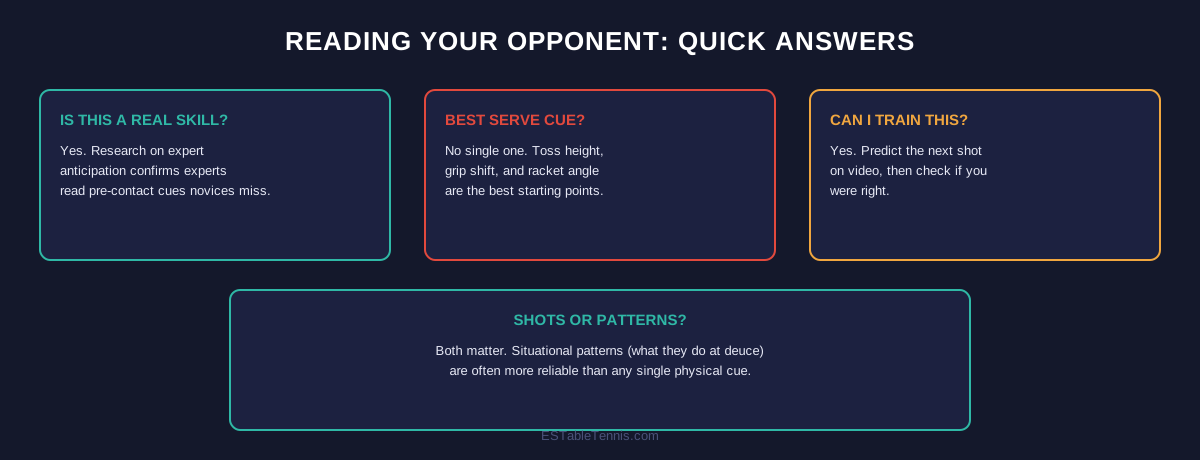
Yes. Research on expert table tennis players shows they process an opponent’s action at both a movement level and a more abstract pattern-recognition level, and classic research on advance cue use in racket sports confirms experts extract information from pre-contact movement that novices miss.
What’s the single best cue for reading an opponent’s serve?
There is no single universal cue, but toss height, grip shift, and racket angle at contact are the three most reliable starting points, and each opponent’s specific tells are worth learning individually.
Can I actually train myself to read opponents better?
Yes. Watching match footage and predicting the next shot before it happens, then checking whether your prediction was correct, is a direct, trainable method used to build this exact perceptual skill.
Is it more useful to read individual shots or overall patterns?
Both matter, but situational patterns (what an opponent does at deuce, or right after losing a point) are often more reliable than any single pre-contact physical cue, since they reflect a repeating psychological tendency under pressure.
What Should You Watch for in Your Very Next Match?
Pick one cue, toss height on the serve, and track it deliberately for one entire match, even if it costs you a little focus elsewhere while you learn to see it. That single habit, repeated across enough matches, is how the gap between reacting to the ball and anticipating the player closes.
For the strategic side of what to actually do once you have read the cue, see table tennis match strategy. And for the mental discipline required to trust an early read under pressure, the MentalEdge Course covers the full system.
Leave a Reply