Table tennis is the world’s most popular racket sport, with over 300 million players worldwide. I was shocked too when I first read that. More people play ping pong than tennis, badminton, and squash combined. And yet, most people treat buying a table like an afterthought, like picking up a cheap folding card table and calling it a day. I made that mistake once. Never again.
I’ve been playing table tennis since my early teenage years, and I’ve gone through more tables than I care to admit. I bought a flimsy $120 thing from a big-box store that wobbled every time someone sneezed near it. The bounce was so dead it felt like hitting a ball against wet cardboard. My friends laughed at me. Fair enough.
The right table makes a massive difference in how much you enjoy the game, how much you improve, and whether your setup actually survives more than one Christmas holiday. Whether you’re shopping for a competitive setup, a backyard table, or something the whole family can enjoy in the garage, this guide has you covered. I’m going to walk you through the best table tennis tables on the market right now, break down what to look for, and share the stuff I learned the hard way so you don’t have to.

What Makes a Great Table Tennis Table?
A great table comes down to four things: tabletop thickness, frame and leg stability, net quality, and whether it’s built for indoor or outdoor use. Okay, so before we start throwing around brand names and price tags, let’s talk about what actually separates a good table tennis table from a total waste of money. Not all tables are created equal, and the differences aren’t always obvious when you’re staring at a product photo online.
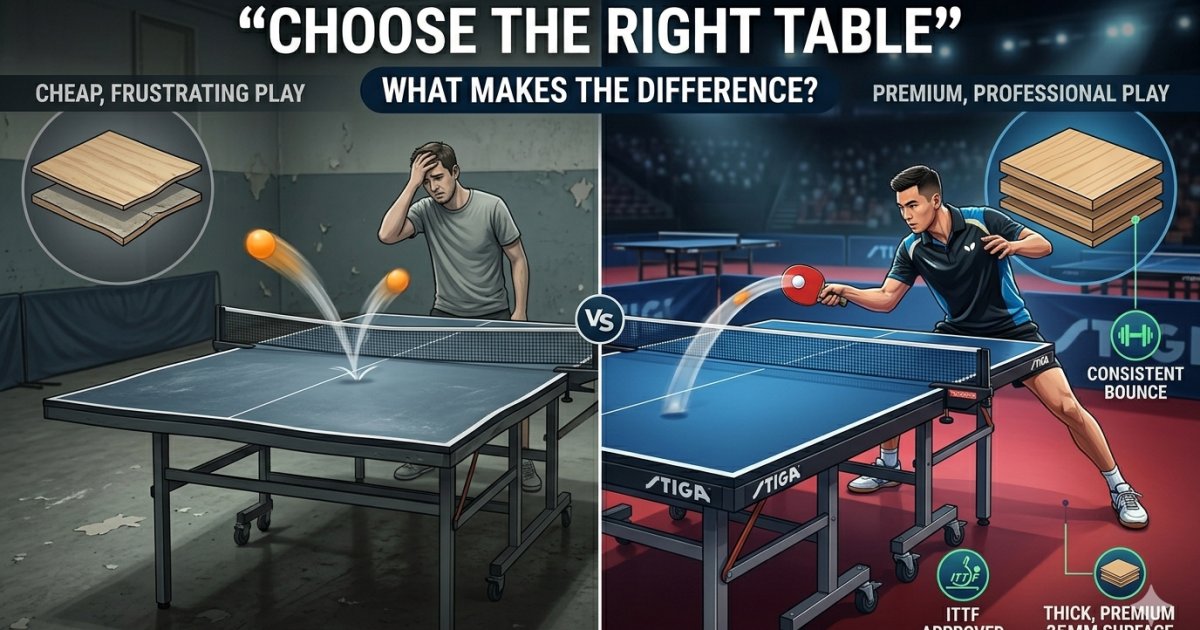
Tabletop thickness is the big one. This is probably the single most important spec to look at. Table thickness is measured in millimeters, and the difference between a 12mm table and a 25mm table is night and day. Thicker tables give you a more consistent, lively bounce, the kind that feels satisfying every single time you make contact. Thinner tables produce a dead, uneven bounce that’ll drive you absolutely nuts after about twenty minutes of play.
Here’s a general rule of thumb I use: anything below 15mm is entry-level, and you’ll feel it in your game. Tables between 15mm and 19mm are solid for recreational players and families. Anything 22mm to 25mm is where the good stuff starts: you get a consistent bounce that holds up to serious play. For competitive or club-level play, you’re looking at 25mm to 30mm, and at that point, you’re typically also looking at ITTF approval.
Frame and leg stability matter more than people think. A wobbly table is a frustrating table, full stop. You want a steel frame undercarriage with legs that lock firmly in place. Some budget tables use thin, flimsy metal that bends over time. I had one table where the legs would literally shift mid-rally if someone bumped the table, and my buddy Dave was not happy about losing points because of it.
Look for tables with adjustable leg levelers. If your garage floor isn’t perfectly level (and most aren’t), you’ll thank yourself later. Some tables have individual leg adjusters that let you fine-tune the height on each corner. That small feature has saved me more than a few arguments.
The net system is something a lot of people overlook. A quality net clamp attaches tightly to the table edge without scratching it, and the net itself should be taut, not sagging in the middle like some kind of hammock. Some tables come with cheap clip-on nets that loosen after a week. A good net set, like the ones from Butterfly or JOOLA, makes a real difference in play quality, and they’re usually adjustable for height.
Indoor vs. outdoor construction is a totally different ballgame. (If you need an outdoor-specific recommendation, I have a full guide to the best outdoor ping pong tables.) Indoor tables are typically made with a Medium Density Fiberboard (MDF) surface, which gives you that crisp, responsive bounce. Outdoor tables use materials like aluminum composite, resin, or specially treated MDF with weatherproof coating. Don’t ever leave an indoor table outside. I learned that one the hard way when I left mine in the garage over a humid summer, and the surface started to warp and peel. It looked like a sad, peeling sunburn.
Playback mode is a feature that gets way more useful than you’d expect. This is where one half of the table folds up vertically so you can practice alone, hitting the ball against the upright panel and having it bounce back to you. It’s honestly one of my favorite features for solo practice sessions, especially if your regular opponent (hi, Dave) bails on you at the last minute. Not all tables have this, so if solo play is something you care about, make sure to check before buying.
One last thing: safety features and locking mechanisms. Quality tables have safety locks that keep the folded halves from accidentally collapsing. This sounds like a minor thing until you’ve got a 200-pound table toppling toward you because the lock didn’t hold. Look for tables with anti-tilt features, especially if you have kids around.
What Are the Best Table Tennis Tables for Home Use?
Now for the actual recommendations. Home tables are probably the most popular category because that’s where most of us are shopping. We want something that fits in the garage or basement, doesn’t cost a fortune, and plays well enough that we actually enjoy using it. Here are my top picks.
JOOLA United Pro 18: Best Budget Pick
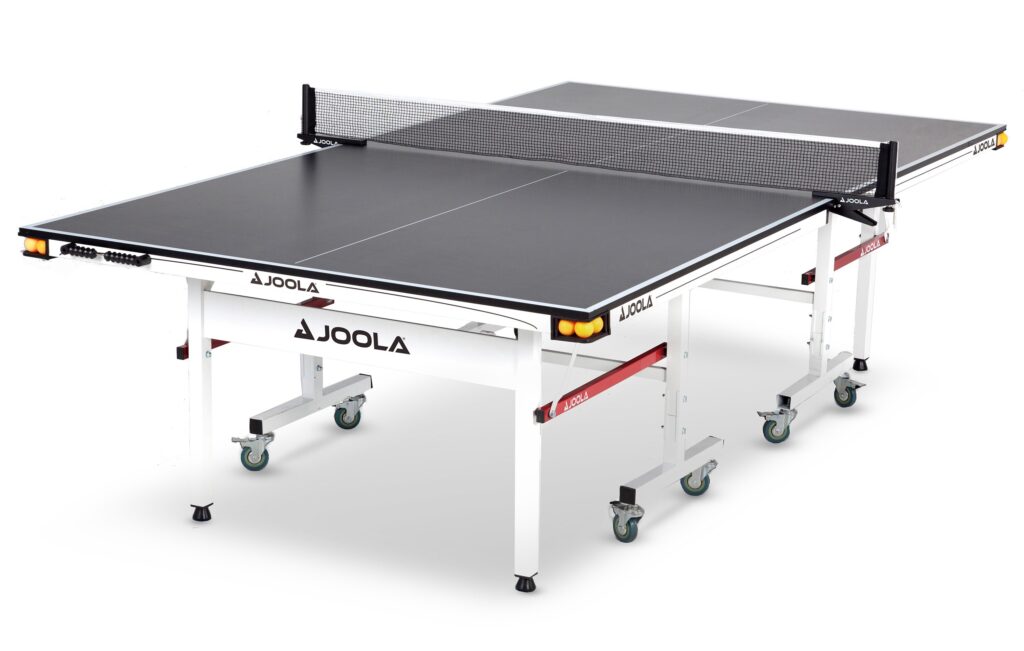
If you’re on a tighter budget and just getting started, the JOOLA United Pro 18 is genuinely the best value at its price point. It’s an 18mm tabletop, thicker than most tables in this bracket, and JOOLA’s surface finishing is noticeably better than competitors at the same price. The bounce is consistent for a beginner table, and the 40mm frame is sturdy enough that it doesn’t feel like it’s going to collapse if you lean on it.
Assembly is pretty straightforward. It comes with a ready-to-install net set, and while the net isn’t anything special, it does the job. The folding mechanism uses automatic folding legs with locking casters on each half, so it folds down fast for storage, which is huge when you’re working with limited garage space. I’d say this is the perfect starter table for families or casual players who aren’t ready to drop serious cash just yet. Just don’t expect tournament-level bounce, because you’re not getting it at this price.
JOOLA Tour 2500: Best Mid-Range Pick

Now we’re talking. The JOOLA Tour 2500 sits right in the sweet spot of price and performance. It features a 25mm tabletop, so you’re getting a legitimately good, lively bounce that rivals more expensive tables. When I first played on this one, I was genuinely surprised at how professional it felt compared to the price tag.
The frame on the Tour 2500 is solid, with a thick steel undercarriage and easy-rolling wheels that make repositioning a breeze. It also has a playback mode, which I use constantly. The surface coating is smooth, and the painted finish holds up well over time. I’ve had mine for going on three years now with no significant wear. If you’re a serious recreational player or a family that plays regularly, this is the table I’d steer you toward without hesitation.
Butterfly Centrefold 25: Best Premium Home Table

Okay, this is where things get fancy. The Butterfly Centrefold 25 is a 25mm table from one of the most respected names in table tennis, and it absolutely delivers. The playing surface is exceptional, with an incredibly consistent bounce, great ball response, and a surface quality that competitive players will appreciate. You can genuinely practice serious technique on this table, and that’s not something you can say about most home tables.
What sets the Centrefold 25 apart is also its build quality and thoughtful design. The folding and unfolding mechanism is effortlessly smooth, the wheels are heavy-duty and roll easily across most surfaces, and the safety locking system is rock-solid. Butterfly’s attention to detail shows throughout the entire product.
It’s a bigger investment, no question about it, but if you’re serious about the game and want a table that grows with your skill level, the Centrefold 25 is worth every penny. My only gripe is assembly took me a solid two hours, and the manual could’ve been clearer.
Space and storage considerations are real things to think about for home tables. A standard full-size table is 9 feet long and 5 feet wide, and you need at least 5 feet of clearance on each end plus about 3 feet on the sides for comfortable play. Most folding tables store in an upright position that takes up about 5 feet by 5 feet of floor space, manageable for most garages. If you’re really tight on space, look into compact or junior-sized tables, but understand you’re sacrificing the standard playing experience.
What Are the Best Outdoor Table Tennis Tables?
Outdoor tables are a totally different product category, and you can’t just buy any table and assume it’ll survive the elements. I made that mistake, left my indoor table on the patio for one summer season, and it warped so badly the ball would take wild, unpredictable bounces. My neighbor thought I was throwing spin serves. Nope. Just a ruined table.
Kettler Axos 1: Best Overall Outdoor Table

Kettler is a German brand with a long history of making serious outdoor tables, and the Axos 1 is their entry-level offering that punches way above its weight class. The playing surface is an aluminum composite material that resists warping, rust, and UV damage. It doesn’t play quite like an indoor MDF surface; there’s a slight difference in bounce quality, but it’s remarkably good for an outdoor table.
The legs are powder-coated steel with adjustable feet, and the whole thing feels incredibly solid. It folds into an upright position with a self-locking mechanism, and the weather cover (available separately) makes storing it outside completely feasible. I have a friend who’s had his Kettler Axos sitting on a covered porch for four years, and it still plays great. That kind of durability is exactly what you’re paying for with outdoor tables.
JOOLA Nova: Best Budget Outdoor

If you need an outdoor table but don’t want to break the bank, the JOOLA Nova is the one I’d recommend. It features a 6mm aluminum composite surface with a weatherproof design, and while the playing feel isn’t as premium as the Kettler, it holds up extremely well to outdoor conditions. The price is hard to argue with for what you get.
The frame is zinc-plated steel, which means it resists rust even in humid conditions. It folds away easily, and the compact storage footprint is a real selling point. I’ll be honest, the bounce quality doesn’t match an indoor table, and experienced players will notice. But for backyard games with family and friends? It’s absolutely perfect. Nobody at a summer BBQ is critiquing table surface tension.
Cornilleau 500M: Best Premium Outdoor And once you have the right table, the free ESTableTennis ebook on the mental side of the game is the natural next step.
If you want the closest thing to an indoor playing experience outdoors, the Cornilleau 500M is the table to get. Cornilleau is a French brand that’s been making outdoor tables longer than most, and their expertise shows. The 500M features a 5mm resin surface that genuinely replicates the feel of MDF better than almost any other outdoor table I’ve tried.
The bounce is lively, consistent, and satisfying. The UV-resistant coating means the color and surface quality hold up season after season. It also features Cornilleau’s unique mat surface finish, which reduces glare in bright sunlight, something I never thought I’d care about until I played on a glossy outdoor table at noon in July and basically went blind.
The legs are heavy-duty, the folding mechanism is smooth, and the whole table exudes quality. It’s pricier than the competition, but for serious outdoor players, it’s the gold standard.
Weather-resistance features to prioritize: When shopping for outdoor tables, look for powder-coated or galvanized steel frames, UV-resistant surface coating, non-rusting hardware (stainless steel or zinc-plated), and drainage holes or designs that prevent water pooling on the surface. Avoid any table that uses standard MDF without heavy-duty weatherproof sealing; it will warp, period.
What Are the Best Table Tennis Tables for Competitive and Club Play?
Okay, now we’re getting into serious territory. If you’re playing competitively, training for tournaments, or outfitting a club space, the requirements jump significantly. You need ITTF-approved tables, serious surface quality, and construction that can handle heavy daily use. These tables cost more, but for the right player, they’re absolutely worth it.
Donic Waldner Premium 30: ITTF Approved Pick

The Donic Waldner Premium 30 is the standard bearer for competitive play. That 30mm MDF surface produces the liveliest, most consistent bounce you’ll find on any table, full stop. When I first played on a Premium 30 at a local tournament, I genuinely paused and thought, “Oh, this is what it’s supposed to feel like.” The difference from recreational tables is not subtle.
ITTF approval means this table meets the international standards for tournament play; surface flatness, bounce height, and dimensional accuracy are all certified. The rolling system is among the best in the business, smooth, easy to reposition, and the locking mechanisms are absolutely bulletproof. Butterfly builds these tables to last decades, not years. If you’re serious about the sport, this is the table to own.
STIGA Optimum 30: Serious Players’ Choice

STIGA is another brand that serious players respect enormously, and the Optimum 30 is their flagship competitive table. The 30mm surface is ITTF approved, and the playing feel is excellent, slightly different character than Butterfly’s surfaces, which some players actually prefer. It comes down to personal preference at this level.
The STIGA Optimum 30 features a particularly robust frame with a reinforced steel structure, and the wheel and locking system are impressively engineered. Tables at this level get moved around a lot in club settings, so the mobility hardware matters. STIGA’s design holds up beautifully to repeated folding, unfolding, and repositioning. I’ve seen Optimum tables in club settings that have been used daily for over a decade and still play like new.
What ITTF approval actually means: The International Table Tennis Federation certifies tables that meet strict specifications, a 23cm bounce from a standard ball dropped from 30cm, an official playing surface color (typically blue or green), and precise dimensions. ITTF-approved tables also go through testing for surface uniformity, which means no dead spots or inconsistent bounce areas. For recreational play, ITTF approval isn’t necessary. For serious competition, it’s non-negotiable.
Surface tension and ball response at this level are genuinely different. The denser 30mm MDF creates a more elastic surface, and energy is transferred back to the ball more efficiently, producing that crisp, satisfying sound and feel that competitive players are chasing. When you’re practicing fast loops, drives, and serves at tournament speed, you need that level of surface response to properly calibrate your technique.
What Should You Know Before Buying a Table Tennis Table?
Budget realistically by tier: under $300 is entry-level recreational, $300 to $800 is the sweet spot for most players, $800 to $1200 is premium, and $1200-plus is competitive-grade. Let me save you some money and a couple of headaches. I’ve made most of the classic buying mistakes at this point, and I want to pass on what I actually know so you can skip the painful learning curve.
Budget breakdown: be realistic with yourself. Here’s how I think about the price tiers. Under $300: You’re getting an entry-level recreational table. Functional for casual family use, but don’t expect premium bounce or long-term durability. $300–$800: This is the sweet spot for most recreational and semi-serious players. You can find genuinely excellent tables in this range, like the JOOLA Tour 2500. $800–$1200: Premium home and semi-competitive tables. Exceptional build quality and surface performance. $1200 and up: Competitive and professional-grade tables. Worth every cent if the sport is serious to you.
Don’t cheap out and then upgrade six months later; that’s exactly what I did, and I ended up spending more in total than if I’d just bought the right table from the start. Been there, done that, got the warped table to prove it.
Assembly: what nobody warns you about. Almost all tables come partially disassembled. Some assembly is quick and intuitive, and some is an absolute puzzle. Read the reviews, specifically looking for comments about assembly difficulty, before you buy. Tables like JOOLA and Butterfly tend to have clear, logical instructions. Some off-brand tables have instructions so confusing they should come with a therapist. I’m only half joking.
Do the assembly with a second person if possible. A lot of the process involves holding a heavy frame in place while tightening bolts, and trying to do that solo is awkward at best and dangerous at worst. I’ve got a bruised shin that can attest to that.
Size standards: know what you’re buying. A regulation full-size table tennis table is exactly 9 feet long, 5 feet wide, and 2.5 feet high. Most tables sold for home use are full-size, but there are also 3/4-size and mini tables available. Unless you’re extremely space-constrained, I’d always recommend going full-size; playing on a smaller table and then switching to regulation size is disorienting. Your spatial sense for the game is calibrated to whatever table you practice on.
Weight and portability are bigger deals than they sound. Better-quality tables are generally heavier; more material means more weight. But heavy tables also usually come with better wheel systems to compensate. Look for tables with large, smooth-rolling casters that lock securely in place. If you need to move your table regularly, the quality of the wheels genuinely impacts your daily experience.
Warranty and brand reputation matter more as you spend more. Budget tables might have a one-year warranty, and that’s fine given the price point. But when you’re spending $500 or more, you should expect at least a three-year warranty, and reputable brands like Butterfly, JOOLA, STIGA, and Kettler stand behind their products. I’ve dealt with warranty claims for a cracked surface, and JOOLA handled it without any drama. That experience matters.
How Do You Set Up a Table Tennis Table at Home?
Measure your space before buying: a full-size table needs roughly 19 by 11 feet of clearance for casual play, and 22 by 12 feet for serious practice. So you’ve bought your table. Congrats! Now comes the part people underestimate: actually setting it up properly so it’s a joy to use rather than a constant source of irritation. I’ve done this in several different spaces and picked up a few things along the way.
Room size requirements: don’t wing this. The table itself is 9 feet by 5 feet, but you need significantly more space to actually play. For casual recreational play, you want at least 5 feet of clearance behind each end line and 3 feet on each side. That works out to roughly 19 feet by 11 feet of playing space as a minimum.
For serious practice, go bigger; 22 by 12 feet is more comfortable. Measure your space before buying the table. I cannot stress this enough. I once set up a table in a room that was technically big enough, but had a structural column on one side that made the backhand side basically unplayable. It was a frustrating few months.
Lighting is something casual players totally ignore. Table tennis is a fast game, and bad lighting creates weird shadows that make tracking the ball genuinely difficult. Overhead fluorescent shop lights are actually great for garage setups; they provide even, bright illumination across the whole table. Avoid a single light source directly above the center of the table, because it creates a bright spot in the middle with dim ends. LED strip lighting mounted along the ceiling perimeter is my personal favorite setup; it’s even, it’s bright, and it doesn’t glare off the table surface.
Flooring matters more for the table than for you. Hard flooring, such as concrete, hardwood, or tile, is ideal under the table because it keeps the wheels from sinking or shifting. If you’re setting up on carpet, look for a table with larger casters that won’t dig in. I had a table on thick carpet for a while, and one of the wheels kept sinking slightly, which made the table imperceptibly uneven. Kept driving me crazy until I figured out what the problem was.
For storage, always fold toward the wall. When you fold your table into its upright storage position, position it so the hinged side faces the wall. This way, if the locks ever fail (they shouldn’t with a quality table, but still), the table falls toward the wall rather than into the room. It’s a simple habit that’s good safety practice, especially if kids are around.
Accessories you’ll want right away: Grab at least three or four quality balls before your first session; they get lost under furniture faster than you’d expect. A decent paddle set for guests is worth having around, because the paddles that come with tables are usually pretty mediocre. A ball catch net (a net that catches balls so they don’t roll all over the floor) is one of those things that sounds unnecessary until you’ve spent ten minutes crawling under furniture retrieving balls.
How Do You Maintain and Care for a Table Tennis Table?
A well-maintained table from a reputable brand lasts 10 to 15 years. Regular care means gentle cleaning, checking frame hardware every few months, and protecting outdoor tables from moisture and UV. A quality table tennis table is an investment, and a little regular maintenance goes a long way toward making it last. I’ve seen well-maintained tables that are 15 years old and still play like new, and I’ve seen neglected three-year-old tables that are warped and peeling. The difference is almost entirely in care.
Cleaning the tabletop correctly. This is something people mess up all the time. Never use harsh chemical cleaners, abrasive cloths, or anything that could damage the surface coating. A slightly damp soft cloth is all you need for regular cleaning. Wipe down the surface after heavy use to remove sweat, oils, and ball marks. For stubborn marks, a tiny bit of mild dish soap diluted in water works fine, just dry the surface immediately afterward.
Do not, under any circumstances, use window cleaner or furniture polish on a table tennis surface. I tried furniture polish once, thinking it would keep the surface nice. It created a slightly slick surface that completely changed the ball bounce and ball grip off the paddle, and cost me a whole session figuring out why my spin wasn’t working. Lesson learned the dumb way.
Protecting outdoor tables is an ongoing job. Even the best outdoor tables benefit from additional protection. A weatherproof table cover is a worthwhile investment; keep it covered whenever the table isn’t in use. This protects against UV degradation, keeps moisture off the playing surface, and prevents debris from scratching the surface over time. In climates with harsh winters, storing the table indoors during the off-season extends its lifespan significantly.
Check the frame hardware of outdoor tables every season, specifically looking for any signs of rust starting at the joints and connection points. Catching rust early and treating it with a rust-inhibiting spray is much easier than dealing with structural rust damage later. Tighten any bolts that have worked loose from vibration and movement over the season.
Indoor tables need the frame checked, too. The undercarriage of a folding table goes through a lot of mechanical stress over the years; repeated folding, unfolding, and rolling around add up. I do a quick hardware check every six months or so, just going through and tightening any bolts that have loosened. It takes about ten minutes, and it’s the single best preventive maintenance habit you can have.
How long should a quality table last? A well-maintained table from a reputable brand should last you 10 to 15 years of regular use, sometimes longer. I know people who’ve had Butterfly and STIGA tables for 20+ years that still play perfectly fine. Entry-level tables have shorter lifespans, maybe 3 to 7 years of regular use, simply because the materials aren’t as durable. This is one of the reasons a mid-range or premium table can actually be the more economical choice over time.
Common mistakes that shorten a table’s lifespan: leaving an indoor table in a humid, unventilated space (MDF is susceptible to moisture damage), storing heavy items on the playing surface (it can cause subtle warping over time), dragging the table across rough floors instead of rolling it (damages the feet and bottom of the legs), and using the table frame as a prop for leaning tools or equipment against it. Treat the table like furniture, not like a workbench.
What’s the Bottom Line on Choosing a Table Tennis Table?
So there you have it, a complete guide to finding the best table tennis table for your needs, your space, and your budget. Let’s do a quick recap of the highlights.
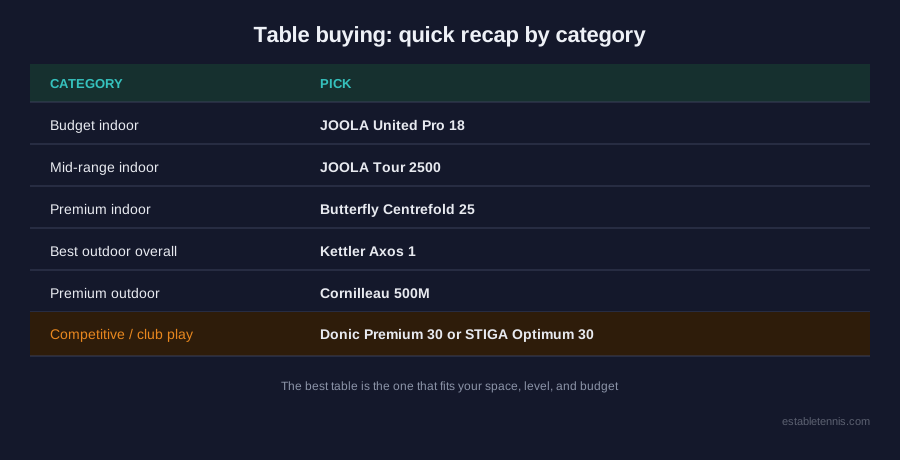
Remember, the best table tennis table isn’t always the most expensive one. It’s the one that fits your playing level, your space, and your lifestyle. A family buying their first table has completely different needs from a competitive club player, and there are great options at every price point. Focus on tabletop thickness, frame stability, folding mechanism quality, and whether you need indoor or outdoor capability. Get those four things right, and you’ll be happy with your purchase.
And please, learn from my mistakes, measure your space before buying, invest in proper accessories from day one, and actually maintain your table. A little effort goes a long way.
Need a racket to go with the table? Check out this post about the best table tennis rackets.
Now I’d love to hear from you: what table are you leaning toward, or do you already have one you love? Drop your experience, questions, or tips in the comments below. The community always benefits from real-world experience, and honestly, nothing beats advice from someone who’s actually played on the thing.
Frequently Asked Questions
What tabletop thickness should I look for in a table tennis table?
22mm to 25mm for serious recreational and semi-competitive play, and 25mm to 30mm for club or competitive use. Anything under 15mm is entry-level only.
Can I leave an indoor table tennis table outside?
No. Indoor tables use MDF surfaces that warp and peel when exposed to humidity and weather. Use a dedicated outdoor table with weatherproof aluminum composite or resin instead.
How much space do I need for a table tennis table?
About 19 by 11 feet minimum for casual play, and 22 by 12 feet for serious practice, accounting for clearance behind and beside the table itself.
How long does a good table tennis table last?
10 to 15 years or more for a well-maintained table from a reputable brand, compared to 3 to 7 years for entry-level tables.
What does ITTF approval on a table actually mean?
It certifies the table meets strict specifications for bounce height, surface flatness, and dimensions, required for sanctioned competition but unnecessary for recreational play.
Once your table is sorted, make sure the paddle you play on matches your game too. Run your setup through PingPath in under two minutes.
Leave a Reply